Unprecedented Agreement Between Armenia and Azerbaijan: Ararat Mirzoyan
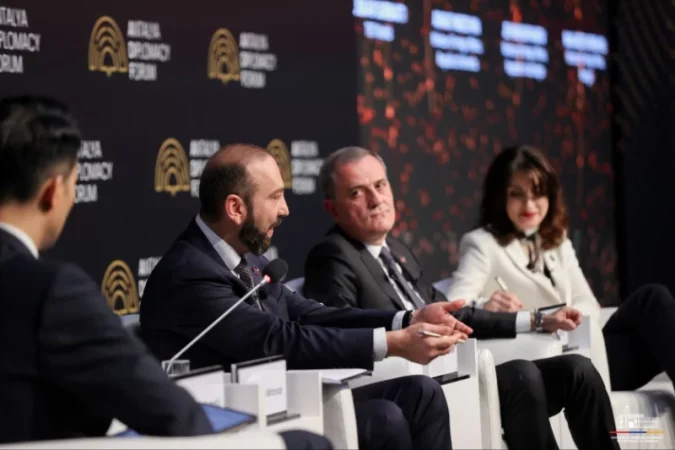
The Ministry of Foreign Affairs of Armenia presented the full responses of the Minister of Foreign Affairs, Ararat Mirzoyan, during a panel discussion with his Azerbaijani and Georgian counterparts. We present them below.
Question: Mr. Mirzoyan, after the successful completion of peace negotiations last month, your Ministry announced that the peace agreement is ready for signing. You just heard the concerns expressed by your Azerbaijani counterpart regarding this agreement. Is Yerevan ready to respond to these concerns? And do you have any issues concerning this agreement?
Ararat Mirzoyan: Thank you very much for the invitation. I also join my colleague in thanking the organizers of this wonderful diplomatic forum. Regarding your question, you know this is a matter of approach. I don’t think dwelling on the past would be constructive at this moment and would help us all reach productive and mutually beneficial solutions.
I would prefer to focus on the present and the future, as if we center on obstacles, historical issues, and start discussing which territory belonged to whom a hundred years ago or who killed more people from the other nation, I believe that together we would lead ourselves into another conflict. Meanwhile, the desire of the Government of the Republic of Armenia and the Armenian people, at least from our side, is to establish lasting peace in our region, including the regulation of relations with Azerbaijan.
You are absolutely right: after lengthy negotiations, we managed to reach an agreement on the text of the draft peace agreement, and we also proposed to immediately start consultations to determine the place, time, and day for signing the peace agreement.
Is this peace agreement, the agreed text, addressing all possible issues? Of course not. And I believe that there is no agreement in the world that addresses all possible questions and includes all possible problems. This is the foundation, this is the beginning of relations. Of course, there are numerous matters that remain open, and we can continue our discussions on all issues, we can keep exploring new opportunities for cooperation, because this is just the beginning.
And it is important to note that there is a provision in this agreed text of the agreement that establishes a bilateral commission to discuss all remaining issues, including those related to the interpretation of certain provisions of the agreement. And again, this is once more a matter of approach: what do we as foreign ministers propose to our societies during this discussion? What do we, as states, propose to the region and the world?
Are we going to return to the past or build a common future and ensure welfare for our citizens? We are confident that all the prerequisites, positive conditions for signing this agreement, starting a new phase of dialogue, a new level, or if you will, opening a new era of relationships, peaceful relations, and prosperity in the South Caucasus and beyond, in a broader region already exist.
This is our approach. Minister Bayramov talked about very specific conditions or prerequisites. You know, it is about the Minsk format. We have expressed our readiness several times to initiate the process of dissolving the Minsk format structures. Those structures can be dissolved when there is no longer a conflict. Thus, this is a rather interesting question: do we have a conflict today or not? On the ground, in fact, there is no conflict, yet at the level of documents, there is no signed and ratified agreement on establishing peace and inter-state relations.
Thus, we can continue to philosophize on this issue, but the solution is evident to us, at least for us. We must sign the agreement, institutionally end this conflict, dissolve those structures on the very same day, if you want, at the same moment, or, I don’t know, 10 minutes later, or one document after another is signed. I’m not even saying which document should be signed first. Let’s sign the peace agreement. Let’s sign a joint application to the OSCE member states or the secretariat regarding the dissolution. Let’s create the bilateral commission I just mentioned and start discussing all possible questions.
Minister Bayramov also talked about the Constitution of Armenia. Well, if you want, I will also say: we also have concerns regarding the Constitution of the Republic of Azerbaijan. And we don't say this simply to express concerns by a mirror principle or to create conditions. I can explain. The Constitution of the Republic of Armenia refers to the Declaration of Independence - the document by which the Republic of Azerbaijan declares itself the successor of the Azerbaijan Democratic Republic. And we all know that the Azerbaijan Democratic Republic declared its sovereignty over much larger territories than that of today’s Republic of Azerbaijan - including more than 60% or so of the current sovereign territories of Armenia.
Thus, this is again a matter of approach. From which side do we start? Should we first have answers to all questions before building relations? Or should we base our relationship on the achievements we already have? Now we have an unprecedented situation: Armenia and Azerbaijan, I repeat, please focus on this fact, Armenia and Azerbaijan have agreed on the text of their agreement recognizing each other’s territorial integrity within the borders that existed at the time of the collapse of the Soviet Union. This sentence provides answers to numerous questions and concerns.
Are we going to build on this foundation, or are we going to undermine this very tangible, historical achievement and then bring another question to the negotiation table, and then another question? This could turn into an endless process. Are we focusing on the future or the past? That is the question.
Question: Mr. Mirzoyan, it seems like you want the agreement to be signed, while the questions will be resolved at a later stage. However, we heard Minister Bayramov's statement regarding constitutional changes; according to him, the Armenian Constitution currently asserts that Artsakh is part of Armenia. Do you accept that this may be concerning for Baku?
Ararat Mirzoyan: Thank you for this question. I officially declare that our Constitution, which is a public document, you may verify and correct me if I am wrong, but I assure you that I am not wrong, there is no expression in the Constitution of the Republic of Armenia stating that Artsakh is part of Armenia. There isn’t. On the contrary, I pointed out that we have our concerns regarding the Constitution of Azerbaijan. But the question is, why do we continuously raise this issue? Because in the very text of the agreement, there are several provisions. One of them recognizes each other's territorial integrity in a formulation that is fully acceptable to both you and us, since we have already agreed on that provision. Furthermore, there is a provision that the parties to the agreement cannot refer to their internal legislation as an excuse for non-implementation of the provisions of the agreement. That is, this has already been addressed.
And the shortest way to comprehensively and clearly solve all this is the signing and ratification of this agreement.
Question: Is your government ready to consider possible changes to the Constitution, even if this may not be well accepted at an internal level?
Ararat Mirzoyan: Thank you once again for this opportunity to respond to my colleague's remark. So, if we delve into the legal nuances, I will provide a brief explanation. You know, legally, yes, there is a reference in the preamble of our Constitution to our Declaration of Independence, but only those provisions of the Declaration that are literally quoted in the main part of the Constitution have legal force and are mandatory.
The sentence regarding which our Azerbaijani colleagues express concern is not quoted in the text of our Constitution. There is merely a general reference to the Declaration of Independence, stating that drawing from the Declaration of Independence, the people of Armenia declare this, this, and then the main text of the Constitution begins. Therefore, again, from a legal perspective, there is only one body in the world that is authorized to interpret and analyze our Constitution. That is the Constitutional Court of the Republic of Armenia.
Last September, our Constitutional Court made a conclusion regarding another document signed between Armenia and Azerbaijan concerning the rules for the joint work of the delimitation commissions. That regulation states that delimitation is carried out based on the Alma-Ata Declaration, which expresses the same idea that our borders are the borders that existed when we were as Soviet socialist republics until the time of the collapse of the Soviet Union. Thus, last September, our Constitutional Court confirmed, and this is a public document, that this principle of borders also implies that we do not have territorial claims beyond these borders, which fully complies with our Constitution. And that is that.
So, if we sign this agreement now, then during the ratification process it will again be sent to the Constitutional Court. If our Constitutional Court again declares that this document is consistent with our Constitution, that will be further evidence that this issue is closed, addressed, and that there are no obstacles. If theoretically, our Constitutional Court says otherwise, that will result in a different situation. In that case, we will come back to you and discuss other possibilities. That's it.
But again, you know, this is a matter of political will. This is a matter of orientation. This is the question of what we focus on: are we building peace, utilizing opportunities, or are we closing the process with concerns? If we have the will to utilize opportunities, then we will find the way.
Question: Given how fragile trust is, are there means by which the leadership of Armenia can reassure its counterparts in Baku that Armenia's current path is irreversible, even if the political winds change in the country or the region?
Araratch Mirzoyan: That was a quite interesting observation, thank you. Of course, I can agree with certain approaches and remarks, and disagree with others, but in one specific instance you pointed out something very accurately. The Armenian society indeed feels vulnerable primarily in terms of security, as well as in economic cooperation or the perspective of closed borders. The ordinary citizen of the Republic of Armenia may hear on the same day assurances and proposals from the government regarding building peace with neighbors, opening borders, turning the page on hostility in the region, and opening a new era.
At the same time, we all remember that there are still extremely sensitive issues. The wounds are quite fresh, and it’s hard to talk about possible cooperation, but the ordinary citizen of the Republic of Armenia may hear or see in his daily life in the newsfeed numerous assurances about this. And on that same day, that same citizen may hear several threats from Azerbaijan, including again threats of using force, declarations regarding the non-recognition of territorial integrity, and threats embodying demands on the internationally recognized territorial integrity of the Republic of Armenia. This can sound from the level of deputies of the National Assembly, from closely related media platforms, from senior officials' level. Thus, that threat is hanging in the air.
There is a choice. For us, for our Azerbaijani, Georgian, and Turkish friends, there is a choice. You can wait another hundred or two hundred years to be convinced that changes are irreversible, or you can start the process by laying one brick, then another, and another, thus building a peaceful region, establishing cooperation for energy projects, transit projects. You pointed to the topic of air connectivity; I can elaborate a little more on that, internet cables, tourism. There are so many paths for cooperation, and I believe that Georgia can lead the way in the region. We can connect societies - not just the societies of Armenia and Azerbaijan, but also Georgia and Turkey.
We live in the 21st century. Again, this is a matter of choice. You can wait another two hundred years, or you can start laying bricks and building a sturdy wall. We choose cooperation, but we cannot cooperate just among ourselves. Our neighbor must also be willing to cooperate from the other side.
For instance, to avoid sounding too idealistic and not shying away from specific details, I will bring an example. We recently offered Azerbaijan to establish communication, through which they would gain access to our railway infrastructure while we would gain access to their regional railway infrastructure. We understand that there is a 45-kilometer stretch in southern Armenia that is probably or perhaps admittedly the shortest route to connect the two parts of Azerbaijan, and we suggested to apply modern technologies. There are electronic scanners that would allow us to avoid the physical inspection of goods, and electronic declorations can be exchanged between respective structures.
This would allow the transit to be executed at maximum speed, and so on. We made a very specific proposal, yet there has been no positive response. Possibly they have reasoned concerns, I do not know, but I repeat, this is a matter of choice.
Նմանատիպ հոդվածներ

Ավելին Politics բաժնից

Ծառուկյանին ձեռնաշղթաներով բերեցին քննչական մարմին. ինչ է սպասվում
Նոր միջուկային գործարք ԱՄՆ-ի և Սաուդյան Արաբյայի միջև. WSJ
ԵՄ-ում Ռուսաստանի դեմ նոր պատժամիջոցների ընդունումը չի հեշտացել. Politico