What is Happening to Ruben Vardanyan and Other Armenians in Azerbaijani Prisons: BBC
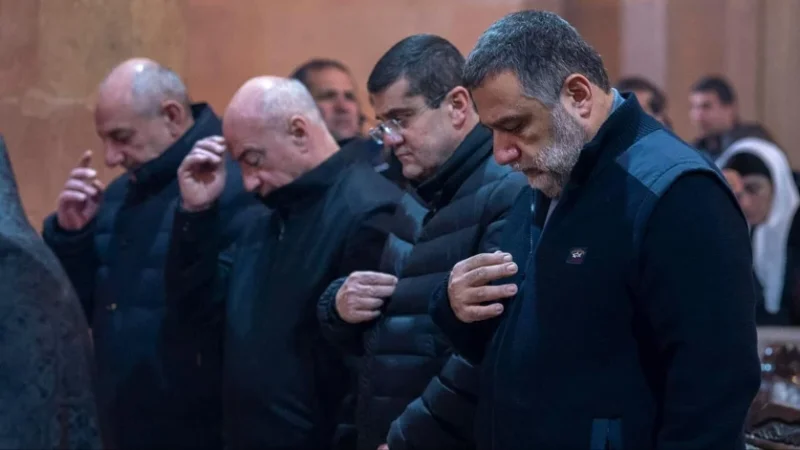
A year ago, Armenians fled from Nagorno-Karabakh following Azerbaijan's military operations. However, not everyone was allowed to cross into neighboring Armenia. The leaders of the Armenian population in Nagorno-Karabakh, including billionaire Ruben Vardanyan, were arrested and taken to Baku.
What awaits the former presidents and ministers of the unrecognized Republic of Nagorno-Karabakh? Who is defending them? And why are hopes for their release linked to the COP29 climate conference?
Journalist Lilit Shahverdyan spoke with their relatives and lawyers for the BBC Russian Service.
In early September, after months of blockade, Nagorno-Karabakh came fully under Azerbaijani jurisdiction. During those days, Azerbaijani border guards arrested eight Armenians—former military and political leaders of the unrecognized Republic of Nagorno-Karabakh.
Among them are three former presidents: Arkadi Ghukasyan, Bako Sahakyan, and Arayik Harutyunyan. However, the most prominent of this group is Ruben Vardanyan, a Russia-based Armenian billionaire who served as Minister of State in the Nagorno-Karabakh government for several months.
Authorities and human rights defenders provide different accounts regarding the exact number of detainees. Baku talks about 23 Armenian captives, including the eight leaders of Nagorno-Karabakh and 15 military and civilian individuals apprehended following the September 2023 conflict. However, human rights advocate Siranush Sahakyan, representing the interests of Armenian prisoners at the European Court of Human Rights (ECHR), believes the actual number of detainees significantly exceeds official figures.
What is happening to the former leaders of Nagorno-Karabakh?
In early September, the Azerbaijani Chief Prosecutor announced that the investigation was complete and that the cases against the former leaders of Nagorno-Karabakh would soon be presented to the court. This was perhaps the first statement regarding their fate since their arrests. A year ago, the arrest of the former officials was actively covered in Azerbaijani media.
Footage was published showing the former leaders being led handcuffed into the headquarters of the Azerbaijani State Security Service, alongside their photographs in detention.
However, no new footage has surfaced since then. In March 2023, the Azerbaijani state TV channel AzTV announced an interview with former President Arayik Harutyunyan and former Defense Minister Levon Mnatsakanyan, but the broadcast was later pulled.
“The broadcasting of interviews depends not only on us. We are faced with the question of how appropriate it is to publish it now,” explained a spokesperson for the channel regarding the cancellation.
Since then, the detainees have not appeared in media. The BBC has been in contact with the family members of two arrested former officials. Both relatives reported having phone contact with the detainees, but they cannot make calls independently. They spoke on the condition of anonymity.
“We know very little about his condition. I don’t know when he will be able to call again—through the International Committee of the Red Cross or other intermediaries. We are in touch, but he does not describe his situation, only says that everything is fine. Usually, I tell him the family news myself,” said one of the interlocutors.
Another detainee’s son described a similar situation to the BBC: “From time to time, he calls us and says that his health is good. There has not been a long period where he has not been in touch.”
The families of the detainees understand that they may not see their relatives for some time. “We hope that he will be released, but we still do not see any real preconditions for that,” a relative told the BBC. He noted that their family had received almost no help from the Armenian government.
The International Committee of the Red Cross (ICRC) is the only organization actively mediating between Azerbaijan and Armenia at a practical level, having physical access to the detainees and ensuring their communication with their families. The ICRC informs Armenian and Azerbaijani media about its visits to the detainees. The last such visit was recorded in August of this year.
Russian billionaire and Karabakh military leaders
Relatives of the former leaders of Nagorno-Karabakh are trying not to disclose details about their conditions of detention for fear of exacerbating their already vulnerable situation. However, Ruben Vardanyan's international legal team has opted for a different strategy. In June of this year, a call was sent to the UN Special Rapporteur on Torture condemning the mistreatment and torture suffered by Vardanyan. The letter states that after Vardanyan declared a hunger strike in April 2024, he was taken to a punishment cell, deprived of food and drinking water.
Lawyers state that the lights in the isolation cell were not turned off around the clock, Vardanyan was forced to stand for long periods, and he was denied toilet paper as well as the opportunity to wash and change his underwear and clothing.
Prominent global figures, from former Irish President Mary Robinson to former French Foreign Minister Bernard Kouchner, have called on Azerbaijan to release Vardanyan. In August 2024, ahead of Russian President Vladimir Putin's visit to Baku, the Union of Armenians in Russia requested him to raise the issue of the Armenian leaders of Karabakh during his negotiations.
Vardanyan was detained in Nagorno-Karabakh for “financing terrorism,” creating illegal armed groups, and illegally residing in Azerbaijan. The other unrecognized Nagorno-Karabakh leaders are accused of torture, engaging in terrorist activities, or inciting national hatred. For instance, Arayik Harutyunyan is accused of mining territory during the 2020 Nagorno-Karabakh war, creating illegal military formations, illegally importing weapons, and shelling Azerbaijani cities.
Arkadi Ghukasian, Bako Sahakyan, and National Assembly President David Ishkhanyan have been charged with terrorism, illegally acquiring and possessing weapons and ammunition, as well as creating armed groups. Former Foreign Minister David Babayan has been charged under more than ten articles of the Azerbaijani Criminal Code.
The BBC has sent an inquiry to the Azerbaijani State Security Service, but no response has been received.
Who is working on the release of detainees?
Over the past year, Baku and Yerevan have begun direct negotiations without the mediation of Russia or the West. Both sides claim they seek to conclude a peace agreement as soon as possible, but something continues to obstruct progress. However, there have been accomplishments, one of which can be considered the border demarcation process between the two countries. Another was the exchange of prisoners of war last December, during which Azerbaijan released 32 detained Armenians, while Armenia returned to two Azerbaijani soldiers and supported Baku's request to host COP29, the 29th session of the UN Climate Change Conference. The conference will take place from November 11 to 22. The former leaders of Nagorno-Karabakh were not included in this exchange.
Armenia condemned the arrest of the former military-political leadership of Nagorno-Karabakh at the level of the Foreign Ministry and appealed to the International Court of Justice. However, the Prime Minister has not prioritized their release among his agenda. Still, there is hope for renewed international attention to this issue. In an interview with the BBC, human rights advocate Siranush Sahakyan and Jared Gensler, representing Ruben Vardanyan's interests, expressed confidence that the approaching COP29 in November could potentially once again draw the world's attention to the issues of prisoners of war and political detainees.
Gensler is a well-known American human rights scholar specializing in political prisoner issues. He emphasized that the international community plays a crucial role in this matter: “There are many actors in international courts who are deeply concerned about everything happening in Azerbaijan. [President Ilham] Aliyev may try to escape or hide from this truth, but that will have enormous reputational consequences for him, which will only increase as COP29 approaches.”
Hopes for the release of detainees connected to COP29 are also tied to statements from Western politicians. For example, in early September, US Senate Foreign Relations Committee Chairman Ben Cardin called on President Aliyev to release Armenian detainees and Azerbaijani activists and journalists who have been detained for covering corruption or human rights abuses in the country. Hosting an international significant event like COP29 should impose obligations on the host country to respect freedom of speech and assembly, wrote the senator.
Officials from the US and the EU also regularly raise concerns regarding the fate of Armenian detainees, urging Azerbaijan to treat them humanely and in accordance with international law.
For activists, who the West stood up for, there have been amnesties in Azerbaijan before, notes Lawrence Broers, a researcher at Chatham House’s Royal Institute of International Affairs. Therefore, it cannot be ruled out that there could be a release of detainees ahead of COP29, but for now, nothing indicates such a prospect.
“I have only heard discussions that it could happen,” said the expert.
Armenia's Position and Pashinyan's Stance
Lawyer Siranush Sahakyan, who represents the families of Armenian prisoners of war in international courts, believes the issue of releasing all detained Armenians should be discussed in the context of peace agreements between Armenia and Azerbaijan. However, she finds the efforts of Armenian authorities insufficient.
“The pressure should come from the international community. Armenia cannot exert the necessary pressure alone. If it remains passive and does not appeal for support from the international community, then the necessary pressure simply will not be there,” says Sahakyan.
Gensler, representing Vardanyan's interests, has rated the efforts of the official Yerevan as a “complete failure.” He insists that even the question of releasing captives is not raised within the framework of peaceful negotiations between Armenia and Azerbaijan.
In response to the BBC's query, Armenia's Foreign Ministry has stated that the return of Armenian prisoners of war, civilians, and former Nagorno-Karabakh leaders is “considered a priority and is always under the attention of the Ministry of Foreign Affairs.”
However, the recent statements from the Prime Minister suggest that at least Vardanyan should not count on Yerevan. During a press conference in early September, Pashinyan effectively shifted the responsibility for Vardanyan's fate onto Russia.
“How was it that Ruben Vardanyan renounced his Russian citizenship? Who advised him to take this step? Who sent him or instructed him to come to the Republic of Armenia, Nagorno-Karabakh, for what purpose, under what conditions, and what promises were made?” the Armenian Prime Minister asked in response to journalists' questions about Vardanyan's fate.
Such insinuations resemble the rhetoric of Azerbaijani state media, which refer to Vardanyan as a Kremlin agent sent to Nagorno-Karabakh. The leaders' positions regarding this issue are so similar that independent journalists directly equate them.
“The official propaganda of Armenia and Azerbaijan has been claiming for several years that Ruben Vardanyan was sent by Putin to Armenia, then to Nagorno-Karabakh,” writes Aram Abrahamyan, editor of the “Aravot” newspaper in his column.
What’s Next?
The outcome of the trials for the leaders of the Armenian population in Karabakh remains uncertain; delays may play to both the detainees' advantage and disadvantage. The COP29 climate conference will likely be the peak moment of international attention for Azerbaijan. The alternative remains a direct agreement between Armenia and Azerbaijan, but for now, that seems improbable. The detention of the unrecognized Nagorno-Karabakh leadership represents a significant symbolic victory for Azerbaijan, states Lawrence Broers. It can be expected that their trials will become a news spectacle that will reinforce Azerbaijan's narrative regarding the conflict in Karabakh.
Baku has recently again dismissed any possibility of leniency towards the former leaders of Nagorno-Karabakh. “Regarding the return of prisoners of war, Azerbaijan is not obliged to release war criminals and representatives of the separatist junta regime,” stated spokesperson for the Azerbaijani Foreign Ministry Aykan Hajizade.
However, the relatives of the detainees are trying not to lose hope. “If the verdict has not been issued yet, then that likely means that something is happening. Perhaps something indeed will change,” shared a family member with the BBC.
Source: News.am
Նմանատիպ հոդվածներ
Russia Responds to Pashinyan's Statement Regarding CSTO
Armenian Government Confirms Investigation into Russian Hackers' Attack on PM's Office Database
Russian Hackers Attack Armenian Prime Minister's Office Database: 'Azatutyun'
We Do Not Set the Task of Returning Occupied Territories by Military Means: Pashinyan
Ավելին Politics բաժնից
ԱՄՆ Կոնգրեսի հանձնաժողովը կոչ է արել Ադրբեջանին անհապաղ ազատ արձակել հայ գերիներին
Ռուբիոն` Լավրովի հետ հանդիպման մասին
ՀՀ նախագահի ինքնազգացողությունը վատացել է․ նա տեղափոխվել է հիվանդանոց. ArmLur