Azerbaijan Seeks to Fully Subjugate Armenia Amidst Russia's Weakness and Europe's Dependence: The Telegraph
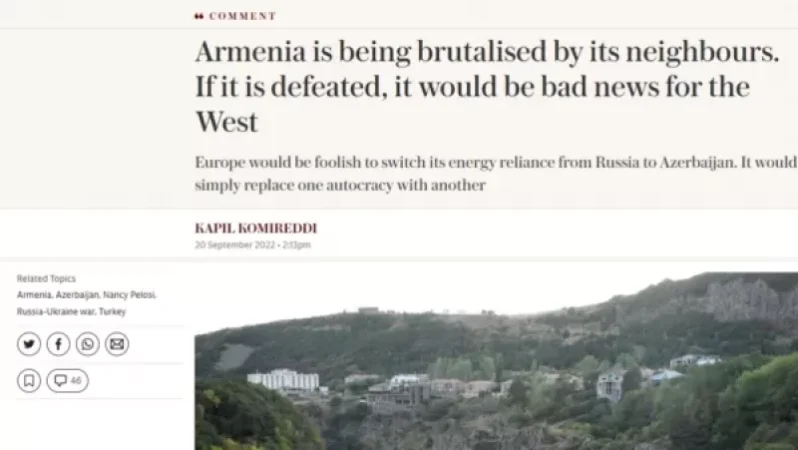
The influential international newspaper The Telegraph has published an article by renowned writer and journalist Kapil Komireddi. Below is a translated excerpt with partial reductions.
“The EU is looking for reliable energy suppliers: Azerbaijan is one of them,” Ursula von der Leyen said in July. Since Tuesday (September 13), the EU's “reliable partner,” a phenomenally corrupt hereditary dictatorship in the Caucasus, has killed more than two hundred people in its merciless assault against its democratic neighbor, Armenia. The massacre in the Caucasus may be shocking, given that after Armenia's defeat in the 2020 war over Nagorno-Karabakh, Azerbaijan's leader Ilham Aliyev has been negotiating with Armenian Prime Minister Nikol Pashinyan. Just two weeks ago, these two leaders shook hands in Brussels.
However, there is so little to be surprised about regarding Azerbaijan's assault—a country that emerges from the disputed territory of Karabakh and targets Armenia directly. Inspired by Europe's deepening dependence on Baku and Russia's weakened state, which has a security treaty with Armenia and has traditionally been a peace mediator in the region, Azerbaijan sees the moment as perfect for fully subjugating Armenia.
The West today is as distracted as it was in the autumn of 2020 when Azerbaijan and Turkey—linked by a “two nations, one state” policy—began joint military operations against Armenia at the height of the coronavirus pandemic, during which Syrian mercenaries paid by Ankara were deployed alongside regular army soldiers. After that war, it was impossible to notice during travels around the region that Azerbaijan's enmity against the world's oldest Christian state, Armenia, was based not only on territorial disputes over Karabakh but also stemmed from a much more sinister factor—the chauvinistic conviction of Turkic peoples of superiority over Armenians. It was a continuation of history. In April 1915, the Ottoman Empire launched a systematic campaign to exterminate the Armenian population. At that time, the two-million-strong Armenian community lived under Turkish rule. Four years later, fewer than 200,000 remained. The rest were either slaughtered, sent to death camps, or starved to death. Countless women and children were forced to abandon their faith and accept the religion of their “masters.” The Armenian diaspora, one of the largest in the world, is a consequence of that genocide.
In fact, the term “genocide” was coined by Polish lawyer Raphael Lemkin to describe the Armenian tragedy. Every Armenian heart is a reservoir of unquenchable sorrow and loss (despite ongoing shame, Great Britain refuses official recognition of the Armenian Genocide). More than a century after that prolonged atrocity, the same murderous rage rises again against Armenians, a people who have traversed through terrifying memories of death, dispossession, and displacement. This past April, on the eve of the Armenian Genocide Memorial Day, Turkish Foreign Minister Mevlut Cavusoglu mocked Armenians mourning their tragic past with a gesture signifying the “Grey Wolves,” a cliché worn by unrepentant Turkish ultra-nationalists. The Armenian Genocide is evidently a source of joy and satisfaction for Turkey and its client in the Caucasus.
The horror of one of the hundreds of killings circulating in the region, which I saw in a refugee's phone from Karabakh, continues to haunt me. It shows how Azerbaijani soldiers behead an elderly Armenian man and then place his head on the carcass of a pig. This horror—beheading, pig—is wrapped in religious symbolism. Human Rights Watch has numerous verified videos of torture of Armenians by Azerbaijani authorities. New horrors are piling on the old. Currently circulating in the region is a video filmed by Azerbaijanis in which an Azerbaijani soldier mocks the dead, displaying the mutilated corpse of a female Armenian soldier—naked, dismembered, eyes gouged out and replaced with stones, partially decapitated.
To ensure no one doubts its intentions, Azerbaijan is working significantly to destroy Armenia's ancient religious heritage in the areas it has occupied. In any other context, such murderous imperialism would be named exactly as it is. But in this context, we employ a genteel euphemism. Imperialism is merely imperialism when it is by Europeans; however, when it is done by Turks, it becomes a program of cultural exchange.
It is hard to find justification for Europe’s pathetic dealings with Azerbaijan. The embrace with Aliyev not only encourages Azerbaijan to pursue its expansionist ambitions but also undermines the much-lauded “values” of the West. Any sins that can be attributed to Vladimir Putin's Russia can equally be attributed to Aliyev’s Azerbaijan. Compared to the accumulated wealth of the ruling dynasty of Azerbaijan, Russian oligarchs seem modest; OCCRP estimates their empire in Great Britain alone at around $700 million. Aliyev's Azerbaijan is also politically more repressive than Putin's Russia. According to Freedom House's index of civil and political liberties, Azerbaijan ranks ten slots lower than Russia. And the militaristic nationalism, protected by the regime, saturated with ethnic hatred towards Armenians, allows his Russian counterpart to seem mild by comparison. Aliyev once opened a museum in Azerbaijan's capital Baku, where the main exhibits were the helmets of Armenian soldiers killed by Azerbaijani forces.
Azerbaijan, armed and controlled by NATO member Turkey, is now paving its way into Armenia's sovereign territory. One of the most unlikely democracies neighboring Russia faces not just an assault but is being forced into self-destruction. Ironically, Europe will gain very little from its commercial partnership with Azerbaijan. Baku, which in turn depends on natural gas imports from Iran and Turkmenistan, struggles to meet its domestic energy needs. Moreover, the Azerbaijani gas field, which is supposed to be a future source for supplies to Europe, is partially owned by the Russian company Lukoil. By paying Azerbaijan, Europe is indirectly enriching Russia. Europe creates the illusion of energy independence from Russia, while the price of its self-deception is borne by Armenians.
Նմանատիպ հոդվածներ
Ավելին Society բաժնից
ՏԵՍԱՆՅՈՒԹ․ ՊՍԺ-ի և Արսենալի երկրպագուները զանգվածային ծեծկռտուք են սարքել
ՏԵՍԱՆՅՈՒԹ․ Ինչ անել, եթե ընտրացուցակներում հայտնաբերվել են մահացած անձի տվյալներ
Գեներալ–մայորին բնակարանն ազատելու ծանուցում է ուղարկվել