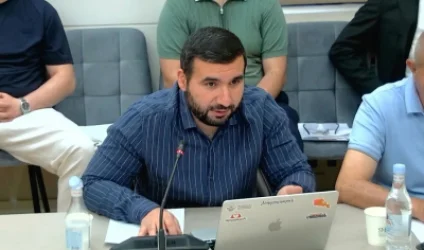
Without Compromise, the Nagorno-Karabakh Issue is Unresolvable: Pashinyan at the Institute of International Political Studies in Milan

The official visit of Prime Minister Nikol Pashinyan to the Italian Republic continues. As reported by the Information and Public Relations Department of the Prime Minister's Office, Prime Minister Pashinyan visited the Institute of International Political Studies in Milan (ISPI) and delivered a speech at the discussion titled "Dialogue About the Future".
In his speech, Prime Minister Nikol Pashinyan stated: "Ladies and gentlemen, it is a privilege for me to be here at the Italian Institute of International Political Studies, one of the largest research centers in Italy and the world. I know that this year marks the 85th anniversary of the institute's establishment. Over the decades, by equally merging research based on politics and education, the institute has passed through the unstable periods of history, contributing to the formulation of global policies.
Once again, I want to thank you for the opportunity to address this audience. Ladies and gentlemen, I have no doubt that you have all heard about the non-violent, peaceful Velvet Revolution that took place in Armenia in April 2018. Without external sponsors, this revolution came as a reflection of the hope of the Armenian people, rejecting the corruption and fraud that had ravaged the country for decades, replacing the supremacy of power with the supremacy of law.
Taking responsibility for conducting protests, I clearly understood that there has never been a more promising and, perhaps, a more dangerous time in the history of third Armenian statehood. I understood that I had no right to leave the thousands of women, men, youth, and the elderly who followed me at the mercy of fate. We started a protest march from Armenia's second-largest city, Gyumri, to the capital, Yerevan. As we approached the capital, the responsibility increased geometrically with every step.
And we succeeded. The Armenian people proved that they are strong when united and cohesive. With the Velvet Revolution, we were able to return power to the people. Our next step was early parliamentary elections. Last December, we held parliamentary elections, which our international partners characterized as free, fair, democratic, and competitive.
This was the first parliamentary election in our country whose official results were not contested in the Constitutional Court and the first parliamentary election whose results were unanimously accepted by all political forces and society in general.
After the elections, I clearly realized that the people's expectations were exceedingly high. It was necessary to channel the energy and emotions arising from the broad mobilization into the process of building democratic institutions. Undoubtedly, democracy has achieved unprecedented victory in Armenia in terms of values and national aspirations. Today, democracy has become part of our identity. However, we understand that democracy must be institutionally strengthened to become irreversible.
We must defend democracy from those who want to take revenge and turn back the hands of the clock. To this end, we initiated reforms aimed at ensuring the rule of law, accountable governance, and the protection of fundamental rights and freedoms. Today, we place emphasis on the establishment of institutions, and the judicial system is of primary importance in this regard.
It is well known that without a genuinely independent judicial system and public trust in the judicial system, it is impossible to have full democracy and the rule of law. But that trust must be earned. For a long time, it has been undermined, and restoring it requires effort. With the help of our international partners, we are bringing it back.
In this context, I want to emphasize the role of the European Union, which has become Armenia's main partner in the establishment of institutions and the implementation of our reform agenda. To this end, the Comprehensive and Enhanced Partnership Agreement signed between Armenia and the European Union is of particular importance. Notably, the CEPA is a reform-generating tool, and its provisions imply qualitative changes in many spheres of our society.
Dear friends, Italy is one of the historical bridges connecting Armenia to Europe. Today, it plays an important role in expanding cooperation between Armenia and the European Union and strengthening political, economic, and cultural relations. We highly appreciate our friendly relations with Italy and are determined to make every effort to strengthen and make them more meaningful.
Historical close ties between our peoples were established back when Armenia and the Roman Empire were neighbors, which is reflected in the four ancient maps on the walls of the Roman Forum. In the first century BC, Armenia was even declared a friend and ally of Rome. The close ties between our ancient peoples are based on shared values and common Christian traditions, which are certainly cornerstones of our friendship.
It is very important for Armenians that the sacred relics of the first Catholicos of the Armenian Apostolic Church are housed in the churches of San Gregorio Armeno in Naples and Nardò. In modern times, one of the key centers contributing to the renaissance of Armenian culture is the island of San Lazzaro in Venice, where the Mechitarists’ congregation was founded three centuries ago. This congregation, which continues to be one of the leading centers of Armenian studies, has played an invaluable role in the education and cultural development of the Armenian people. It is yet another point of pride for both Armenians and Italians.
This series can go on indefinitely. The traditional friendship between our peoples has created a solid foundation for the development of cooperation between our countries. Today we have decided to do our utmost to further deepen our relations.
Economic cooperation is an important component of our relationship. Italy is Armenia's second largest trade partner among EU countries. Only in the first nine months of this year did trade between the two countries grow by about 14 percent. The Comprehensive and Enhanced Partnership Agreement between Armenia and the EU and Armenia's participation in the Eurasian Economic Union create additional prospects for the development of cooperation between our two countries.
The Armenian community in Italy is undoubtedly another factor contributing to our cooperation. We are grateful to the Italian government for caring for the Armenian cultural heritage present in Italy. And finally, we appreciate the decision of the Italian Chamber of Deputies recognizing the Armenian Genocide earlier this year.
Ladies and gentlemen, you know that Armenia is located in an unstable region with many security risks and challenges. Unresolved conflicts still exist in the South Caucasus, leading to ongoing tension, an arms race, and a policy of hatred.
Thirty years after the fall of the Berlin Wall, two of Armenia's borders—those with Turkey and Azerbaijan—have remained closed for nearly three decades. By refusing to establish diplomatic relations with Armenia and closely supporting Azerbaijan against Armenia and Nagorno-Karabakh, Turkey continues to pose a serious security threat to Armenia and the Armenian people, who suffered in the Ottoman Empire's first genocide of the 20th century and are still witnessing the fierce denial of truth and justice.
Although our two borders with our friends, Georgia and Iran, are open, they can only be considered semi-open in terms of economic efficiency. The foreign policy challenges coming from our other two neighbors limit the potential for our external economic relations and hinder opportunities for broader regional cooperation. However, our greatest security challenge is the Nagorno-Karabakh conflict. It remains unresolved, becoming a constant source of tension and threatening to lead to renewed military actions in the region.
Anyone interested in the Nagorno-Karabakh conflict should know the background of the conflict. This conflict is not simply a territorial dispute, as some try to present it simplistically. It is about the right to self-determination, human rights, and the physical security of the people living there. The roots of the conflict date back to the early days of the Soviet Union, when the Armenian region was handed over to Azerbaijan by the arbitrary decision of the Communist Party, with a population of 95 percent ethnic Armenians. This occurred as a result of an agreement reached between Bolshevik Russia and Kemalist Turkey in the early 1920s.
During Soviet years, the conflict manifested itself in systematic and violent discrimination against the Armenian population, who declared their desire for self-determination just before the collapse of the Soviet Union, in 1988. In response to the desire of the Armenian population of Nagorno-Karabakh, the authorities of Soviet Azerbaijan took severe measures to thwart this movement through military force. Ethnic cleansing accompanied by mass atrocities against Armenians was carried out in many regions of Nagorno-Karabakh and Azerbaijan.
Then, as the Soviet Empire was going through the process of disintegration, Azerbaijan, like other republics, also declared independence from the USSR. According to the Soviet Constitution, if any member-republic announced its intention to separate from the USSR, the autonomous regions under its jurisdiction had the right to determine their status, including separation from that republic.
Utilizing the Soviet constitution, the Nagorno-Karabakh Autonomous Oblast exercised its right to self-determination. Nagorno-Karabakh declared independence from Azerbaijan just as Azerbaijan separated from the Soviet Union. This time, the Azerbaijani authorities used military force against the Armenians. They launched a large-scale war, threatening the very existence of the people of Nagorno-Karabakh. In response to this existential threat, Armenians, who constituted about 80 percent of the total population of Nagorno-Karabakh, resorted to self-defense. They managed to defend their land and force Azerbaijan to accept the new reality. As a result, a ceasefire agreement was signed between Azerbaijan, Nagorno-Karabakh, and the Republic of Armenia on May 12, 1994.
The negotiating process aimed at resolving the conflict began back in 1992, before the signing of the ceasefire agreement. The OSCE Minsk Group, which received a mandate from the international community to mediate the resolution of the conflict, established that the conflict has three parties: Azerbaijan, Nagorno-Karabakh, and Armenia. This fact was reaffirmed in numerous international documents from the early '90s. Indeed, for a long time, Nagorno-Karabakh participated in negotiations as a party to the negotiation process. In the early '90s, several meetings were even held among the leaders of Nagorno-Karabakh and Azerbaijan, as well as among the Defense Ministers of Azerbaijan, Nagorno-Karabakh, and the Republic of Armenia.
By the way, the prominent Italian politician and diplomat Mario Raphaelini, who made great efforts to resolve the situation in the region, was the president of the Minsk Conference— the first international figure entrusted with resolving the conflict in the early '90s. The Minsk Group meetings, which also included elected representatives of Nagorno-Karabakh, took place in Rome, the Italian capital. Unfortunately, despite the efforts of international mediators over the decades, the Nagorno-Karabakh conflict remains unresolved.
What are the reasons for this situation? First and foremost, the Azerbaijani authorities refuse to negotiate with representatives of Nagorno-Karabakh. They insist that Nagorno-Karabakh should be considered an inseparable part of Azerbaijan. But this is indeed a very strange position. On one hand, Azerbaijani authorities want Nagorno-Karabakh to be part of their territorial integrity. On the other hand, they do not want to negotiate with representatives of Nagorno-Karabakh. Isn't this a bit peculiar?
What does their stance mean? It means that the Azerbaijani authorities effectively do not want to negotiate with the people of Nagorno-Karabakh simply because they want the territory but not the population. More precisely, territory without people. It means that they hope to resolve the conflict through military means— that is, to capture the territory of Nagorno-Karabakh, conduct ethnic cleansing, and get rid of both the Armenians and the problem itself. "The military solution cannot be excluded," is a characteristic statement made by President Aliyev on numerous occasions.
“At any moment we can solve the issue through military means,” was stated in a declaration made during a government meeting on the country's economic development in January 2017. "We will increase our military strength, and I believe that this is one of the major factors in the negotiations." These words were spoken on November 5, 2018. In a statement made on December 17, 2018, it was said: "… our military forces and our strength are the main factors in resolving the Nagorno-Karabakh issue." Indeed, there are many reasons to believe that the Azerbaijani authorities are preparing their public for war. This is why they incite anti-Armenian sentiments among their people. This is also why they expend huge resources on arms. This is why hate speech against Armenians has become official policy in Azerbaijan.
This policy sometimes even has ridiculous manifestations. Just a few days ago, a driver was detained in Baku simply for listening to Armenian pop music. But the most tragic and cynical event was the case involving Ramil Safarov, who murdered his Armenian classmate with an axe while sleeping during a NATO seminar in Budapest. He was sentenced to life imprisonment and later extradited to Azerbaijan by the Hungarian authorities. After that, he was welcomed as a national hero in Azerbaijan. President Ilham Aliyev pardoned him, raised his military rank, and granted him housing.
Dear friends, despite all these circumstances, Armenia is making concrete steps toward finding an acceptable resolution to the conflict. To this end, nearly a year ago, I publicly stated that any resolution to the Nagorno-Karabakh conflict must be acceptable to the people of Armenia, the people of Nagorno-Karabakh, and the people of Azerbaijan. I was the first Armenian leader to voice such a position. I faced severe criticism in my country for this formulation, which considers the three parties on equal footing. Nevertheless, I am convinced that this is the only way to achieve a peaceful and lasting resolution to the conflict, as it implies the possibility for compromise, mutual respect, and balance.
In order to move forward, I expect a similar statement from Azerbaijan. If we hear such a statement from President Aliyev, it would be a real step forward in the negotiation process. However, Azerbaijani authorities remain firm in their previous positions, aiming to resolve the issue solely through a version acceptable to the Azerbaijani people. This gives me additional reasons to believe that Azerbaijan harbors hopes of resolving the conflict through military means and does not wish to find a solution at the negotiation table.
However, Azerbaijani authorities must understand that there is no alternative to peaceful negotiations and a peaceful resolution of the problem. First and foremost, it is absolutely futile to speak the language of threats to the people of Artsakh—Nagorno-Karabakh and Armenia. That is a road to nowhere. Azerbaijan has previously attempted to communicate with the people of Nagorno-Karabakh in the language of force and has faced serious consequences, despite its overwhelming superiority in both population and armament.
Attempts to take revenge for their own military failures will lead to nothing good. Military escalation in our region will have disastrous consequences even from a global perspective. By embroiling themselves in military adventurism, Azerbaijan could create a fertile ground for those terrorists who have lost their footing in Syria and Iraq and are now seeking new territories for their activities. Geographically, Azerbaijan could serve as a base for their penetration into the region from all four directions—south, north, east, and west.
Dear friends, Nagorno-Karabakh is a very complex and painful issue for the peoples of the region. It cannot be resolved without serious and consistent efforts, without compromise, mutual respect, and balance. But if we take responsibility for the future of our peoples, we must strive for real change. I mean the governments of Azerbaijan, the government of Nagorno-Karabakh, and the government of Armenia. We are sincere in our aspirations to establish peace in the region and are ready for dialogue toward a solution to the conflict that will be acceptable to the peoples of Armenia, Nagorno-Karabakh, and Azerbaijan. This is our approach, and we are ready to negotiate based on this new paradigm.
In concluding my remarks, I would like to say that before coming here, I visited the institute's website and was struck by one of the discussion titles: "Ink is better than blood." There has been enough bloodshed in this conflict. Now we need ink and strong hands to put an end to it and bring peace to the peoples of our region. Thank you for your attention. I am now ready to answer your questions."
Prime Minister Nikol Pashinyan responded to a series of questions relating to Armenia's foreign and domestic policies, the reforms being implemented in our country, democratic processes, Armenia-Italy relations, and more.
Նմանատիպ հոդվածներ
Ավելին Politics բաժնից
Հայաստանը չի արձագանքի Իսրայելի նախաձեռնությանը․ ԱԳՆ-ն բացատրել է պատճառը
Եթե պետական բյուջեից ֆինանսավորվեին ու Դիսնեյլենդից՝ Միկի Մաուսին տշեին, «Բոլորին դեմ եմ-ը» ավելի շատ ձայն կհավաքեր
Արթուր Հովհաննիսյանն առաջադրվել է որպես «Քաղաքացիական պայմանագիր» կուսակցության ղեկավար մարմնի` վարչության թեկնածու