1 Ton of Cocaine Could Not Be Intended for the Armenian Market: NSS Reserve Officers' Union
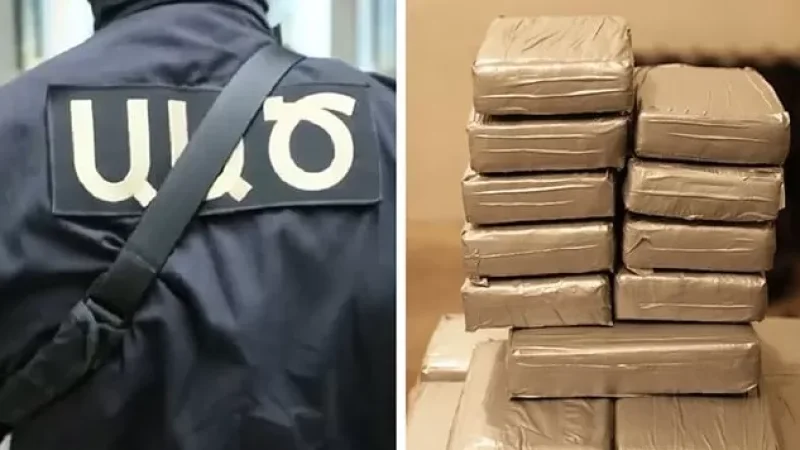
1 ton of cocaine could not have been intended for the Armenian market. This is stated in a statement released by the National Security Service (NSS) Reserve Officers' Union.
“The unprecedented increase in the scale of illegal drug trafficking in Armenia objectively raises public concern, providing ground to assume that conditions are deliberately being created to dull the population’s awareness, weaken vigilance, and diminish activity. The published official data, along with the created situation, indicate that the struggle against drugs needs radical changes; otherwise, this phenomenon will not be prevented, and it will deepen, turning into a serious security threat.
In light of this, we will try to present our vision, an analysis of both the overall struggle against illegal drug trafficking in Armenia and the recent case of cocaine smuggling weighing around 1 ton that caused great noise.
In the context of the general struggle against illegal drug trafficking, criminal cases related to drug smuggling under Article 267.1 of the former Criminal Code of the Republic of Armenia were assigned to the investigative jurisdiction of the NSS. The same criminal composition was also competent for investigation by the State Revenue Committee inspectors; however, according to established practice, if a large quantity of hard drugs was caught at the border, these cases were also entrusted to the NSS by the prosecutor's office to ensure comprehensive detection of the crime and thorough investigations.
There were numerous cases, with drugs weighing from over 1 ton to grams being discovered: heroin, cocaine, morphine, methamphetamine, methadone, hashish, hashish oil, and other types that were imported into Armenia for both local sale and transfer to other countries.
Large consignments of drugs were hidden in cargo or passenger vehicles in specially prepared secret compartments, which could only be discovered using Rapiscan equipment installed at customs checkpoints or based on preliminary intelligence data.
For the detection of drugs using Rapiscan equipment, the customs officer's accurate, attentive, and conscientious work is crucial; otherwise, they might overlook visible features indicative of the presence of drugs. Smaller quantities of drugs are mainly transported via mail or by individuals hiding them in clothing, on their bodies, or in luggage. Recently, the delivery of drugs in parcels has gained significant popularity, where orders are placed and paid online, and the seller informs where the drugs are hidden, thus transferring them to the buyer.
Generally, illegal drug trafficking is classified among hard-to-detect crimes because those involved employ all possible means to conceal the circumstances of drug transport and sale. Huge sums of money are exchanged in these shadow transactions, and thus, the corruption risks are also great.
The main role in preventing and detecting illegal drug trafficking within the country is assigned to the police, while the NSS specialized unit has a significant role in the development and implementation of state policy in the fight against drug smuggling, which, in our opinion, is not sufficiently ensured and has a dire need for improvement and progress.
According to us, to enhance effectiveness, the following actions should be prioritized:
- Increase the number of NSS operational staff serving the sector, improve their professional training, and establish clear requirements and criteria for evaluating work effectiveness.
- Form an information data accumulation, control, and analysis center within the structure, from where real-time tracking of customs operations can be conducted, especially in relation to the data of the Rapiscan equipment, which will naturally increase its efficiency on-site.
- Implement dual and independent control over the loads, accumulate data on individuals potentially related to drug smuggling, and establish constant operational monitoring of them, meaning having infiltrated individuals to clarify actual activities, stable connections, contact circles, sources of income, etc.
- Based on the center’s analyses, forecast the main smuggling routes and conduct enhanced control together with the customs body, operational escort, activate and deepen cooperation with external partners to receive maximum data about movements towards Armenia, and also implement advanced practices in the fight against illegal drug trafficking in Armenia, endowing NSS relevant operational unit employees with broader powers.
For instance, enabling them to independently inspect all vehicles, shipments, and loads with reasonable suspicion, without the customs body, while persons holding state positions, including government members and MPs (and in specific cases, their close family members) must also undergo drug tests for possible use within a maximum of one year prior.
These are unavoidable steps to be taken; otherwise, a systemic breakthrough will not be recorded, and the current level of the struggle will have an imitative, formal nature, and only isolated cases will be uncovered randomly or as a result of one or two operational measures.
Regarding the smuggling case of a 1-ton cocaine consignment, after the publication on May 16, 2023, about the detection of approximately 2.7 tons of cocaine in Italy being sent from Ecuador to Armenia, our political opponents began unfounded speculation that the transport of this drug was allegedly sponsored by the current Armenian authorities. Days later, based on the data from the criminal case being investigated by the NSS, the authorities began to respond, directly accusing the previous authorities, represented by Mihran Poghosyan, of drug smuggling.
Such speculation regarding a criminal case initiated by such an important incident, especially in the initial stage of the investigation when nothing has been firmly established and the data is extremely initial, is simply inadmissible, particularly when facts and accusations are presented at the level of the head of state that still require in-depth verification, analysis, and correlation with other evidence, because such actions inadvertently direct, mislead, and adjust the investigation according to the interests of the ruling political team.
The factual data we received from the press and our sources are as follows: three containers loaded with bananas were sent from the Republic of Ecuador (South America) to Armenia in mid-March 2023. After a few days, the cargo arrived in Panama by ship and, subsequently, in mid-April, in Italy, and immediately set course for the Batumi port of Georgia, arriving there by the end of April. The three trucks entered Armenia from Georgia on May 1, during the daytime, and arrived at the customs terminal in Yerevan on the same day, where the customs procedures were carried out. The already cleared cargo was immediately transported from the terminal on May 2, 2023, by the same trucks to the warehouse of “Mrgani” company, where unloading and storage operations began around 16:30.
It is significant that the bananas imported by three trucks were not going to be re-exported to any other country from Armenia and were intended solely for local sale.
Essentially, the cargo has passed through the territories of five countries (Ecuador, Panama, Italy, Georgia, Armenia); therefore, it underwent corresponding customs control in all these countries without any checks, through the use of Rapiscan equipment, but the drugs were not detected. It is notable that there were no operational data regarding their presence; otherwise, the cargo would have been under operational control, a controlled supply would have been conducted, and smugglers would have been arrested immediately after clearing the cargo or at the time of further sale, and not days later, which occurred in this case when the drugs were voluntarily presented 11 days later.
In particular, the integrity of the containers remained unbroken; they were opened for the first time by the Armenian customs officers on May 2, 2023, at the corresponding customs terminal in Yerevan, after which the trucks arrived at the “Mrgani” company warehouse, and unloading operations began around 16:30. This indicates that Mihran Poghosyan’s video statement released on May 27, 2023, is not staged; it is real and clearly shows that the trucks were arriving at the warehouse for the first time and opening up at that moment, taking place in a natural and unconstrained environment. This is very important for us because it confirms the following facts:
- The truck was unloaded not secretly, under ordinary conditions, during the daytime, and in a publicly accessible place in the main warehouse, in the presence and participation of approximately ten workers.
- The boxes of drugs in the truck were not concealed in compartments; they were simply placed in the middle area of the truck bed, i.e., in a visible and easily noticeable position.
- Moreover, the packages of the drug weighing about 1 ton were placed under number 42 boxes not in a concealed manner; they did not even have banana ties, and there was a quite large rectangular opening on the upper part of the boxes, through which it was visibly clear that packages were placed instead of bananas; in other words, the inside of the boxes was visibly discernible.
Essentially, the smugglers did not have the intent or concern to hide or conceal the drugs from customs; this implies that they were likely colluding with customs officers. For instance, when, in any country along the logistic route, the trucks were opened by customs officers under the pretext of physical inspection, the smugglers would have the opportunity to remove the drugs from the truck with the silent agreement of customs officers, but this did not happen for unknown reasons, and the cargo arrived in Yerevan.
Bananas transported by three trucks from Italy were to be sold in Armenia; they were not to be re-exported to Russia or any other country. It is notable that Ecuador has not joined the restrictions imposed on Russia, and the bananas could have been exported directly to that country, which we emphasize because it establishes the following facts:
- 1 ton of cocaine could not have been intended for the Armenian market, as it was simply impossible to safely sell or store such a huge quantity of drugs here in a reasonable short period.
- If we add the 2.7 tons of cocaine seized in Italy to this, which allegedly was also to be transported to Armenia, it results in about 3.7 tons of cocaine to be sold here, which is unreasonable.
- If the drugs were intended for the Russian market, they would have been smuggled directly to Russia hidden within banana shipments from Ecuador because there was no restriction; and if intended for Western European markets, they would not have been transferred through Georgia to Armenia and then back to Europe because it is illogical.
In general, experience has shown that Armenia has always served as a transit zone for such large quantities of drugs, transporting them to primary markets in Western European countries or Russia.
Essentially, about 1 ton of drugs could not have been intended for the Armenian market; moreover, in this case, Armenia could not have been a transit route either, as we reiterate that drugs could have been transported from Ecuador to Russia directly and much more easily than through Armenia. It makes no sense to carry them to Western Europe through Armenia, especially since the cargo had been transported here from Italy.
Notably, in the last year, several discoveries of such large quantities of drugs smuggling have been made worldwide. For instance, in mid-May 2023, Russian FSB agents discovered around 500 kg of cocaine in two trucks traveling from Russia to Poland, and just days earlier, Dutch customs discovered over 3.5 tons of cocaine in a banana container at the port of Rotterdam, which had arrived from Ecuador. Even if we hypothetically assume that the 1 ton of cocaine discovered in Yerevan on May 2, 2023, and the 2.7 tons of cocaine announced in Italy on May 16, 2023, were intended for Armenia, it would imply that similar drug transportations by the “Mrgani” company could have also contained drugs, indicating that a steady route for trafficking has been established; this is unlikely, considering that such volumes of drugs being sold and collecting enormous amounts of money to return to suppliers could not escape the attention of law enforcement, no matter how much it was protected by the authorities.
To ensure that the total of the aforementioned 3.7 tons of cocaine could not be consumed in Armenia, a simple calculation can verify this: as of January 2022, there were officially registered 7,570 drug addicts in Armenia; unofficial estimates suggest that their number is around 30,000, who naturally use various types of drugs. A cocaine user might consume an average of 20 mg of this type of drug daily. Thus, the mentioned 3.7 tons of cocaine would, in the least calculation, amount to 7.4 tons once mixed with various food powders during retail sales. In this case, if we hypothetically assume that the 30,000 drug addicts in the country would have the opportunity and desire to use this expensive drug, it would mean that at the rate of daily consumption, the aforementioned 7.4 tons of cocaine would be consumed over the course of approximately 35 years, which is, of course, impossible in Armenia.
The drug weighing around 1 ton found in 42 boxes was detected in the warehouse of “Mrgani” LLC around 16:30 on May 2, 2023, and has not been moved from that location, nor has there been an attempt to re-export, sell, or hide it elsewhere from Armenia. On May 13, 2023, Mihran Poghosyan voluntarily informed the NSS director about the presence of drugs, prior to which no law enforcement body had dealt with the issue. In other words, the subject of smuggling - the drug - was actually presented voluntarily, which is an encouraging norm, and the individual based on this is exempt from criminal liability, even if he was the one who committed the smuggling.
It should be emphasized that smuggling is a deliberately committed crime, therefore there must be substantial evidence that the accused individuals are related to the commission of smuggling and the illegal circulation of drugs.
At 08:41 on May 16, 2023, the first information about finding approximately 2.7 tons of cocaine in a consignment of bananas heading to Armenia was published on the Italian website ILMESSAGERO.IT. At 10:38, the same information was published on the РИА НОВОСТИ site, and by 12:04 and 12:14, it was published in the Armenian media by panorama.am and armtimes.com, respectively. On May 17, 2023, the NSS reported about the discovery of the trafficking of about 1 ton of drugs into Armenia.
On May 24, 2023, at 16:10, Melita Ghazaryan, the head of purchases and imports at “Mrgani” LLC, was arrested by the NSS, shortly after which the NSS released a second statement regarding this incident. At 16:30 on the same day during a Q&A session with the government at the National Assembly, Armenia's Prime Minister Nikol Pashinyan commented on the inquiry regarding this case posed by the ruling party MP Armen Khachatryan, essentially positively assessing the fact of the alleged discovery of drug smuggling by law enforcement, also mentioning the recent first arrest in connection with this criminal case and stating that the addressee of this 1 ton of cocaine was the company known for its banana imports, whose owner is now a former member of parliament under investigation.
On May 25, 2023, the NSS arrested Samvel Galustyan, the warehouse manager at “Mrgani” LLC, and on May 26, the director Leon Atajanyan. On May 27, 2023, Mihran Poghosyan appeared on the internet with a video statement regarding the drug smuggling case, detailing that he informed the NSS about the presence of drugs brought to Armenia, adding that “Mrgani” LLC basically belongs to him. On May 29, 2023, the NSS initiated criminal proceedings against Mihran Poghosyan and announced a manhunt, which was reported by the NSS on May 30, 2023. Since then, no other information related to the case has been published.
Indeed, the chronological analysis of the aforementioned events shows that:
- The drug, about 1 ton of cocaine, was voluntarily surrendered to law enforcement by Mihran Poghosyan on May 13, 2023; there are no data indicating he acted under duress or under threat of exposure.
- The Italian law enforcement agencies did not provide information to their Armenian counterparts regarding the smuggling of these drugs before May 13, 2023, i.e., before Mihran Poghosyan’s notification to the NSS; otherwise, “controlled supply” operational intelligence measure would have been executed, and had it been indicated, then Armenian law enforcement agencies, including the police, have demonstrated inaction since no actions were taken towards “Mrgani” LLC.
- During the period from May 2 to May 13, 2023, Mihran Poghosyan did not inform law enforcement of the drug's presence due to objective or subjective reasons, which is not essential, as he did nonetheless surrender it voluntarily on May 13, 2023.
- Immediately following the arrest of Melita Ghazaryan, the head of purchasing and importing at “Mrgani” LLC, by the NSS on May 24, 2023, at 16:10, Prime Minister Pashinyan made his statement as mentioned earlier in the National Assembly, indicating that the arrest may have been pre-coordinated with the Prime Minister for political purposes to counter rumors regarding the protection of smuggling by the current authorities and to direct accusations at “the previous ones.”
Նմանատիպ հոդվածներ

The Response of the NSS Director on Ashot Pashinyan's Use of State Protection

Armenia's Constitution Turns 28: Today is Constitution Day
Suspicious Deal and Mysterious Businessman: Armenians in Jerusalem Outraged by Elite Construction in the Old City

Two Armenian Women Die of Hunger in Sudan: Official Yerevan Confirms
Ավելին Society բաժնից

Մահացել է գերությունից վերադարձած Կարլեն Ստեփանյանը
Քաղաքացի է որոնվում

Մատենադարանն առաջին օգնություն կցուցաբերի