Prisoner of War Describes How 62 Were Captured in the Khzraberd-Hin Tagher Area
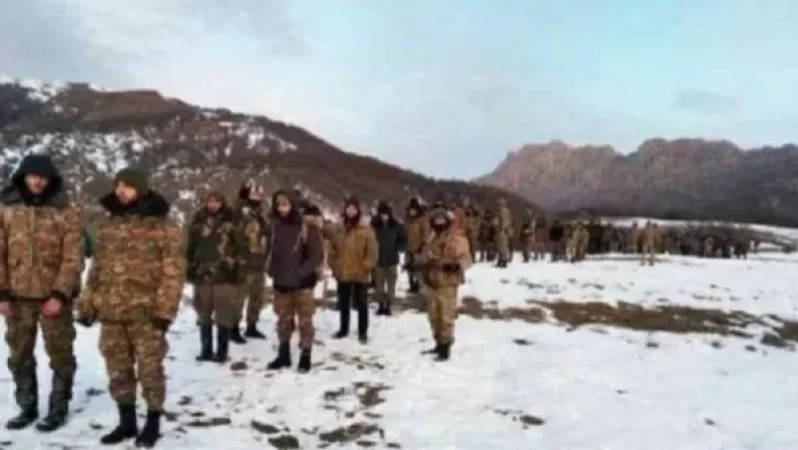
In December 2020, more than a month after the ceasefire was established, Artsakh lost two more Armenian villages, Khzraberd and Hin Tagher, leading to the capture of 62 soldiers. The information was shocking, especially when certain circles in the information field suggested that 62 Armenian servicemen were captured by seven Azerbaijanis. Over the past year, there has been no official statement condemning Azerbaijan's occupation of Khzraberd and Hin Tagher, nor has there been any mention of the need to return Armenian lands in statements following trilateral meetings between Armenia, Azerbaijan, and Russia. The Armenian side has never indicated the return of these villages as a precondition, deepening suspicions about what exactly transpired and how our soldiers were captured.
“Factinfo” spoke with two of the soldiers who returned from captivity, asking them to present the dark history of their capture and the loss of these Armenian villages. It turns out that the soldiers ended up under Azerbaijani blockade without being informed. Moreover, the Armenian servicemen were instructed not to fire if they encountered Azerbaijanis, but to report to their command instead.
Returned prisoner of war M.A. recounted that the battalion, consisting of 100 personnel, was deployed to Hin Tagher on November 27, with 62 positioned while the other 38 went with the commander to another location for a scheduled rotation. They ascended to combat positions to commence a 14-day defense, but the rotation never arrived. "There were tents in the positions, but there were no amenities. The rotation simply did not come. As a soldier who has served, I imagined there would be combat positions, but we only saw tents—there was no means to be comfortable, plus it was winter and cold. During those 14 days, we had sick personnel, one was coughing, another injured his leg, and under those cold conditions—with no sleeping accommodations or means to warm up—we carried out combat duty for 17 days. Communication equipment—radio and phone—worked intermittently and at different locations. Some personnel were stationed far away at the food supply point, from where they provided rations for the battalion. We saw the commander only once on the day we were positioned," said the returned prisoner.
According to him, the battalion commander was Arsen Ghazaryan, and the remaining officers were mobilization officers, Arman Muradyan, and Khov, who were soldiers like them and had been encouraged during service. “The command structure was far from us; we saw the leadership only once when they brought us to our positions and showed us the area, saying, ‘this is where you will carry out combat duty.’ After that, we never saw the commander; communication was via phone,” he added.
During combat duty, they noticed that Azerbaijanis were carrying out construction work in the neighboring village. The enemy's presence increased and they reported that movement towards them was intensifying. “We reported to our immediate superior that they were deploying, moving closer to us, and that the firing was increasing. We asked, ‘Are we in a blockade?’ The response was, ‘No, there’s no such thing, we will extract you, a rotation is coming, and similar assurances.’ According to our interlocutor, the situation was first reported to the immediate leader, and then to the ‘kombat’ who gave the same response: ‘There’s no such thing; whatever happens, you will be rotated out, and we’ll guide you with our commands, don’t listen to other talks.’”
During the rotation, there were no battles or firefights, just notes on how the enemy's troop numbers increased over the course of 17 days. “If initially we saw them from a distance, they later moved closer. Movement was noticeable in the Khzraberd-Hin Tagher area. We were in an elevated zone, and they were below. The movement was evident.” The soldiers from Armavir were informed about leaving the positions, while those from Shirak were not. It was December 13 when the new rotation had still not arrived, and the Shirak soldiers remained in their positions. They were not alone; at a bit more distance were soldiers from Armavir’s MOB, and it was from their positions that they first received strange information.
“We received news from the mobilization in Armavir that they would leave their positions by five o’clock, as if they did not, the enemy would launch an overt attack. Additionally, we were told that those positions would be handed over to the Turks, as we were in a blockade. Some of our guys decided not to base their actions on these words and sought clarifications from higher command. At that time, the response was that we should carry out our combat duty, and if anything happened, we would be kept informed, guided by our commands, and there was no need to listen to other conversations,” recounted the returned prisoner.
Later, a Shirak service member established contact with their commander and instructed them to leave their positions, marking the food supply point as the rendezvous location from where they were supposedly to return home by vehicle. “By five o’clock, we were still in positions. We received a call from him saying to come, take whatever you can, we’re going home. There was a spot on the road to the position called ‘Kung’ where a military vehicle was parked, in the Khzraberd area from where we took food; we were to be there, and Ford vehicles were waiting to take us back to the battalion. I can’t imagine how a rotation would occur if we were descending and there was no one to replace us in the positions,” the soldier reminisced, noting that the only way to reach there was to walk, a journey taking two to three hours on foot. Until that day, food and other supplies had been delivered to positions on foot or by horse.
There were 62 servicemen in the positions while the other 38 were at a different location. They passed the command to each other, took essential items, only uniforms and weapons, and moved toward the designated location where their commander had supposedly been waiting for them. The road was challenging and difficult to traverse; they walked on foot with just one horse. “We climbed to the specified location, where we did not find our commander and tried to establish contact, but that did not work either. We tried to use radio communication and telephones to find out if someone was waiting for us, monitoring us, if they were aware of our situation, but we could not reach them by any means. Some phones did not connect, and others went unanswered,” said the soldier. They also could not establish communication via the internet, either sending a message or making a call. During this time, they noticed that Azerbaijani military units were already stationed at the Armenian positions previously occupied by Armavir’s MOB, realizing that in the current situation, there was only one path left—to go towards the position where the other personnel had been, under the command of Arsen Ghazaryan. Assuming they might be expected there, they continued on foot in that direction, another two-hour trek.
“Some of our physically fit guys, one on horseback, advanced a bit closer to the Kung area, where our personnel was stationed. They saw fire and tried to get closer to signal for increased fire support because we were exhausted from the long journey. There were guys who couldn’t walk—we were carrying some two to three guys who had collapsed, and some were being carried on our backs,” recalled our interlocutor. The ahead group returned after a while and reported hearing conversations in Azerbaijani and Russian. “During our combat duty, we had received an order that if, by chance, we encountered the enemy, we should not initiate fire, as it was the post-war period, and we should not escalate the situation. It was said if we met with Azerbaijani soldiers, they would be accompanied by Russians.”
Following the command, should they encounter Azerbaijanis, they were to maintain a specific distance and report to higher command for additional guidance or wait for them to come and resolve the matter on-site. At that moment, it was not possible to establish contact with command. Finding themselves in uncertainty, the soldiers, seeing the lights of their observation devices from the mountains, thought they were their comrades, only to realize later that they were being followed by not Armenian, but Azerbaijani forces. “One of us, the first, had reached a distance where he was captured. Two or three of ours remained behind, saying they could hear sounds. We realized we were in a blockade—with Turks on the upper positions watching us. We were in a particular spot seeing a lot of fire and hearing many personnel noises, we understood we were trapped. We decided to enter into negotiations to understand what was happening. We stood at a certain distance, in that darkness on one stretch of the road were they, and on the other side were us. We tried to stop at a distance where we could clearly hear each other, but we couldn’t see one another,” he described.
M.A. recounted that from negotiations with the Azerbaijanis, they understood that the 38 personnel of their battalion had exited their positions. “There are video recordings and evidence of how they passed near those positions of Azerbaijanis. From a distance, they shouted, asking how many we were, we answered we were 30. They said, ‘You are more than 30; we know you will come, we are waiting for you.’ They said, ‘You will be over 60 when everyone joins, call us again.’ About 15-20 minutes later, the personnel who had remained behind approached, we all gathered again, called out again. They said, ‘Wait, we’ve contacted the Russian peacekeepers, they will arrive soon, we’ll tell them.’”
After waiting for some time, the Azerbaijanis assured them that the Russian peacekeepers were aware. They collected their weapons, bound their hands and said to wait for the peacekeepers. “They said, come closer, according to security protocols, do not bring weapons out, to avoid firing and escalation. Once the peacekeepers arrive, they will take your weapons, and we will all go our ways together. One by one we approached them; there were many from their personnel—it was a checkpoint. One serviceman was checking us with seven to eight personnel, including our clothes to see if there were other weapons. Behind them were many others; I can’t specify a number—there were over 100 because after the personnel checked, I saw them lined up in battalions and later dispersed. With our hands bound, they took us near the firing and said, wait, the peacekeepers are coming, and thus deceived us, we reached Baku fortress.”
“I realized we weren't going home when their special force commander said you will move, where you will meet the Russians and hand over to the Russian peacekeepers, also your phones and weapons,” he said. However, they later threatened that any manifestation of resistance would lead to the execution of two Armenian servicemen. “I understood I was in captivity. We walked for a day until we reached one of the villages in the Hadrut region, guided by them. We moved on foot until about 6 p.m. and around 3-4 p.m. we reached a village in Hadrut, from where we were taken to Baku by Kamaz trucks.”
“There were 62 of us, walking in a single file; beside each of us, there were accompanying personnel. Each armed officer watched over two men. In front of us was the turn of their personnel. They were rotating regularly. After reaching a certain area, they greeted us, and then the next personnel would escort us.” The serviceman said it was impossible to resist; they had their weapons loaded pointed at the captives, and the Armenian servicemen were completely exhausted. In addition, from the onset, during negotiations, they were already under direct fire. “If we had attempted to show any resistance, they would have killed us all. We were on the road, gathered together—there was no chance to position ourselves or any opportunity to conduct a battle. They guided us along the entire route, waiting until we reached the desired location, where we could be taken captive.”
A soldier who had hoped to meet the other group was recalled to an area where they thought fellow Armenian soldiers would be making tea for friends and was captured. “One of our personnel who had inadvertently approached them, thinking they were our guys, was immediately seized. When we got closer, we tried to speak to him. We said we wished to see him to ensure everything was fine. Because we had been told that the 38-strong group had passed by, some were outside, and there was some factor of the Russian peacekeepers. On the way to Khzraberd, we saw peacekeepers’ vehicles and soldiers. This circumstance was calming.”
While in “Kung”, Azerbaijani officers tied the hands of the 62 servicemen, disarmed them, and made promises for assistance. At that moment, they did not observe any aggressive actions from the enemy. “They just engaged us in conversation by the fires. We tried not to answer questions. They offered us food, and cigarettes. We attempted not to partake in food and water, as this behavior seemed suspicious. Initially, their demeanor was friendly, but then, on the way, once they reloaded their weapons, everything changed for the worse. No offers of food or water; they applied physical force on the defenseless—shoving, hitting—under the influence of weapons.”
The soldier stated that during the entire time in the Baku prison, he never lost hope. “At every dawn and dusk, I prayed in my mind that one day a door would open that would take me home, and as for the guilty, there is a criminal case opened,” said the returning prisoner, expressing hope that everything would be disclosed in time. “Why did the enemy appear behind us? Why were we unaware that we were in a blockade, why weren’t we told we could engage in battle? Those questions I hope will be elucidated, and justice served against those responsible that brought innocent people to captivity or were involved in the death of an innocent person,” M.A. emphasized.
Նմանատիպ հոդվածներ
Defense Ministry Releases Name of Fallen Soldier
Urgent: Two Injured, Gunfire Has Ceased - Official
Photos: Twitter User Living in Azerbaijan Publishes Church Bell of Armenian Origin Inscribed with Shushi
‘That advertisement is everywhere’: Tigran Hakobyan proposes a 2-3 year postponement of the gambling advertising ban for media
Ավելին Society բաժնից
ԲԱՑԱՌԻԿ․ ԱԱԾ նախկին տնօրեն Արթուր Վանեցյանն առողջական լուրջ խնդիրներ ունի

Լավ լուր․ առողջության ապահովագրություն բոլորի համար. ինչ ծառայություններ կներառվեն
Տեղեկություն Նուբարաշեն» ՔԿՀ-ում հացադուլ հայտարարած անձացից