Current Agreement Contains Clauses That May Threaten the Foundations of Armenia's Statehood, Says Aram I

Aram I, the Catholicos of the Great House of Cilicia, has issued a special proclamation addressing the situation in Armenia and Artsakh, the consequences of the war, and future actions.
In the proclamation, Aram I emphasized that the current agreement requires significant revision, as it includes clauses beyond the ceasefire that could "endanger the foundations of Armenia's statehood and territorial integrity".
Additionally, the Catholicos commented on the return of numerous families displaced from Artsakh. He highlighted the necessity for the Armenian authorities to continue efforts for the return of prisoners and the search for missing soldiers.
Among other issues, Aram I emphasized that the right of the people of Artsakh to self-determination must remain inviolable, the international recognition of the Artsakh Republic should become a priority, and the digital and economic growth of the people of Artsakh should hold a central place in the pan-Armenian agenda.
Below is the text of the proclamation in full:
“As is known to our people’s children, this year, His Holiness Aram I proclaimed the 'Year of Artsakh.' Indeed, on Sunday, January 10, 2021, during the Holy and Immortal Divine Liturgy held at the Mother Cathedral of St. Gregory the Illuminator in Antelias, the Apostolic proclamation was read by His Eminence Archbishop Shahan Sarkisian. Below is the full text of the Apostolic proclamation:
To the Archbishops, the clergy, the National Authorities, and our people’s children at the threshold of the year 2021, we warmly greet the National General Assembly, the National Central Administration’s Religious and Political meetings, the Unity, the Archbishops, and the National Authorities from the Mother Monastery of the Great House of Cilicia, with Christian love and paternal blessings.
We warmly welcome our beloved children of the people. We pray to the Almighty God that the New Year be filled with health, success, and happiness in our national, family, and communal lives.
We had declared the year 2020 as the 'Year of Special Care for the Needy.' In this regard, we made consecutive visits to numerous charity and humanitarian centers, expressing our paternal support while acknowledging all those nationals who play a crucial role in the aforementioned organizations that care for our children in need of special attention.
However, the subsequent crises that arose throughout the year did not allow us to develop and implement organized and consistent programs in this direction. Nevertheless, our concern and commitment remain unchanged.
Indeed, the past year, 2020, was filled with numerous and diverse crises for humanity and particularly our people. Firstly, the dangerous situation created by the COVID-19 pandemic had a profound impact on every aspect of societal life. A catastrophic shock was inflicted upon humanity; the pandemic caused numerous infections and fatalities, as well as an economic crisis. The pandemic continues at the same pace, regardless of the preventive measures adopted and the advancements in medical fields, including the vaccine development.
Naturally, Armenian life is also burdened by the severe consequences of the pandemic in Armenia, Artsakh, and the Diaspora. Moreover, for the Armenian community in Lebanon, 2020 also brought forth crises. The economic hardships that escalated within the country created serious material concerns for our families and organizations. Furthermore, the devastating explosion at the Beirut port on August 4 led to Armenian casualties, injuries, and widespread destruction.
Both the Patriarchate and the local dioceses and our organizations fulfilled their utmost duty to assist the needy families by rebuilding ruined homes and guiding the Armenian community in Lebanon toward recovery.
In this regard, the material and moral support from the Armenian government, the Armenian Apostolic Church, and the Patriarchates of Jerusalem and Istanbul, as well as our dioceses and communities, and individual nationals played a significant role in the recovery of the Armenian community in Lebanon. Support continues regionally under our sponsorship with the participation of our three communities, political parties, and charitable organizations.
Since September 27, 2020, the Armenian people have been experiencing another grave crisis, surpassing the earlier crises: the attack of the Azerbaijani and Turkish joint armies on Artsakh. Indeed, the shock caused by the war in Artsakh was unprecedented in the last century of our people's history. For decades, we prayed, conveyed messages, wrote songs, and above all, believed that Artsakh is ours and that we would 'prevail' against this imposed war. However, the opposite happened. Much of Artsakh was occupied by Azerbaijani forces, resulting in hundreds of casualties and injuries, destruction of monasteries and homes, and a significant number of families becoming displaced.
The heavy damages of the war continue to affect our children in Artsakh and Armenia.
Therefore, considering our people's firm connection to Artsakh and the right to its sovereignty and independence, and driven by the expectation to center our concerns and actions on Artsakh, we declare the year 2021 as the 'Year of Artsakh.'
We are confident that our people’s children are, to some degree, familiar with Artsakh; some have visited Artsakh, while others have even settled there. However, on this occasion, we find it necessary to convey some essential information regarding the geography and history of Artsakh, a significant part of historic Armenia, and thereafter, we would like to make some highlights and assertions.
Artsakh Yesterday and Today
Located on the eastern side of the Armenian land, Artsakh, with its towering and impregnable mountains, deep gorges, dense forests, and expansive plateaus, has historically been a bastion of Armenian identity and the forefront of national liberation struggles against foreign conquerors and oppressors.
Artsakh's borders, one of the fifteen provinces of historic Armenia, are bounded by Utik to the east and northeast, Siuniq to the west and southwest, and the Araks river to the south. Artsakh is divided into fifteen regions, with its major cities being Shushi, Hadrut, Martuni, Stepanakert, Askeran, Martakert, Talish, and Parajoz.
Almost all rivers in Artsakh originate from the western and southwest highlands and hills and flow eastward and southeastward. Artsakh also has mineral cold and hot springs. Approximately half of its area is covered by various and diverse dense forests rich in fruit and wild species. Artsakh is also rich in a variety of fauna and minerals, including copper, lead, gold, iron, sulfur, marble, limestone, tuff, sand, and clay deposits.
Overall, Artsakh's climate is dry, with cold and snowy winters, pleasant springs, sunny summers, and mild autumns.
The land of Artsakh is fertile. Thanks to its rich pastures, Agribusiness is highly developed, particularly beekeeping. The dialect spoken in Artsakh has subdivisions, and various regions and villages have their distinct accents.
The people of Artsakh have historically been known as skilled carpet weavers. Since ancient times, Artsakh has been part of the Armenian statehood. The Greek historian and geographer Strabo mentions the province of Artsakh within Greater Armenia. King Tigran the Great built a city named Tigranakert in Artsakh.
After the proclamation of Christianity as the state religion in Armenia, St. Gregory the Illuminator's grandson, St. Gregor, who was ordained as a bishop in Caesarea, became the first bishop of Artsakh and Aghvank and founded the monastery of Amaras. Aghvank's Catholicosate was established in the region, with its first Catholicos being Bishop Abas of Artsakh. This Catholicosate transferred to Gandzasar monastery in the 14th century and was subsequently turned into a diocese in 1815. The Church of St. Amenaperkich became a symbolic stronghold of Artsakh. Artsakh had numerous monasteries that became centers for culture and education, with Gandzasar Monastery serving as a focal point for the liberation struggle and culture. Artsakh was rich in churches and sanctuaries.
Throughout history, Artsakh has given our people numerous spiritual, educational, social, and political figures, including the blessed memory of Karekin I, Catholicos of the Great House of Cilicia.
Artsakh maintained its political autonomy and sovereignty for a long time, even during the Arab rule over Armenia. During the 13th and 14th centuries, it faced frequent invasions by Turkish-Mongolian and Turkmen nomadic tribes. From the 16th century onwards, as the national picture of the Armenian world began to change and Turkish tribes began to gain dominance, the term “Karabakh” started to be used instead of Artsakh.
At the end of the 19th century, five principalities known as the Khamsa Melikdoms were established to resist Persian and Turkish rule in Karabakh. After the establishment of Soviet power, Artsakh was occupied by Azerbaijan, and in 1923, under the intervention of the Soviet Union, the Nagorno-Karabakh Autonomous Oblast was established. The liberation movement of Artsakh began in 1988 with the collapse of the Soviet Union, and in 1991, the Republic of Artsakh was proclaimed, with Shushi being liberated on May 9, 1992. The liberation of Shushi became a symbolic beacon for the national renaissance of Artsakh.
Today, much of Artsakh's territory is occupied by Azerbaijan. Over the course of its multigenerational history, Artsakh has faced similar shocks but has always endured and survived. It is contrary to the spirit of the Armenian people to succumb to defeat; its strength lies in faith and hope. The only way to achieve victory amidst the shocks to the Armenian nation is through a steadfast struggle grounded in belief, in defense of its rights.
REGAINING AND RECONSTRUCTING
As we mentioned, in the early days of the collapse of the Soviet Union, thanks to our heroic sons, the independence of Artsakh was proclaimed, along with the liberation of new territories, with the goal of maintaining the security of the Republic of Artsakh. This new situation was intolerable for Azerbaijan. Attempts by Azerbaijan to reclaim Artsakh and the captured territories made no headway, and a ceasefire agreement was reached between Armenia and Azerbaijan in 1994. Following the ceasefire, political negotiations were held under the auspices of the Minsk Group, comprising the United States, Russia, and France, lasting around 15 years. Armenia's initial approach always remained the same: the Republic of Artsakh must become a participant in the negotiations, the return of the liberated territories and the determination of Artsakh's legal status must be conducted concurrently, as an inseparable whole, and the people of Artsakh must reaffirm their right to sovereignty. Azerbaijan’s approach has always been to return the occupied lands, insisting that Artsakh is part of Azerbaijan's territorial integrity and that the issue of its autonomy can be reviewed in the future.
The negotiations have apparently failed to find common ground between these opposing approaches. Azerbaijan attempted on various occasions to impose its demands through military means, particularly during the April 2016 four-day war. In response to Armenia's and Artsakh's uncompromising stance, Azerbaijan signed a military agreement with Turkey, integrating mercenaries from Syria and other countries, and on September 27, launched an unexpected attack across all fronts in Artsakh. The Azerbaijani and Turkish forces, armed with modern and superior weaponry, did not only subject the Armenian military to horrific bombardment from the air and ground but also directed their assaults on all cities and villages of Artsakh, causing numerous casualties and extensive destruction.
The war lasted 44 days; the Armenian armed forces bravely resisted the massive Azerbaijani and Turkish armies. Considering the heavy losses and geopolitical ramifications resulting from the war, the United States, Russia, and France repeatedly called for a ceasefire. However, Azerbaijan did not respect the agreement it signed. Following this, under the initiative and supervision of Russia, an agreement was signed among Armenia, Azerbaijan, and Russia. The government and political figures of Armenia, Artsakh, and the Diaspora, as well as our people, have serious reservations regarding this agreement, given the ambiguous and uncertain clauses that could be detrimental to Armenia's security and independence.
In light of the current situation, we would like to make a number of crucial highlights and reminders:
- As we said, the current agreement requires substantial revision, as it includes clauses beyond the ceasefire that could threaten Armenia's statehood and territorial integrity. Therefore, it is essential for the Armenian government to pursue both the flawless implementation of the agreement and significant reform, simultaneously demonstrating a more effective diplomacy while closely monitoring the Minsk Group negotiations.
- During the war, a large number of families from Artsakh sought refuge in Armenia. Following the establishment of the ceasefire, it is necessary for them to return to Artsakh and restore their homes and livelihoods with direct support from the state. The physical presence and digital growth of the people of Artsakh are crucial for both security and political reasons.
- The Armenian government must continue to pursue efforts for the return of prisoners and the search for the missing, as well as to provide special care for the injured and support for the families of fallen soldiers.
- The protection of Artsakh's religious and cultural sites should be pursued especially within the framework of the agreement signed between Armenia and Azerbaijan, and should also be guaranteed by the Minsk Group and UNESCO.
- The international recognition of the Republic of Artsakh should become a priority. In this regard, purposeful action should be taken by the governmental and political structures and responsible individuals of Armenia, Artsakh, and the Diaspora.
- The reconstruction of Artsakh, in all its territorial, economic, state, political, and other aspects, requires pan-Armenian programming, participation, and commitment. Our nation faces a colossal challenge. It is impossible to restore Artsakh through temporary programs and ongoing work. Therefore, a national investment and the mobilization of resources for the regeneration of Artsakh are more than essential. We consider the role of the Diaspora as pivotal in this context.
- Finally, let us not forget that new geopolitical conditions have arisen in the Caucasus that are not favorable to Armenia and Artsakh. In this situation, it is necessary to develop a new strategy and tactics, be vigilant, realistic, and united, while avoiding steps that may lead to internal tensions.
In light of our reminders and suggestions, we would like to emphasize that under all circumstances:
- a) The right of the people of Artsakh to self-determination must remain inviolable.
- b) The international recognition of the Republic of Artsakh should become a priority.
- c) The digital growth and economic development of the people of Artsakh should take a central place in the pan-Armenian agenda.
From these thoughts and expectations, we send a paternal call to our communities:
- Firstly, in 2021, through lectures, publications, and various initiatives, to keep our collective will and commitment to restore Artsakh alive in the life of our people.
- Secondly, through special events and competitions, especially instill in our new generation a living presence of Artsakh with its past, present, and especially future vision.
- Thirdly, through our relations with our immediate surroundings and particularly with international organizations and circles, underscore the imperative of the people of Artsakh’s right to self-determination.
- Fourthly, to work toward ensuring that our wealthy nationals and entrepreneurs provide material support for various programs in Artsakh, as well as for economic investments.
Why and how did we lose the war imposed upon Artsakh? Various interpretations will and naturally must be made in this regard. It is essential that a comprehensive and substantive account be given to our people by the authorities of Armenia and Artsakh.
We should not lose hope; our will must not weaken. Though we faced defeat on the battlefield, our nation and homeland have not been defeated and will never be. Let us remember the Battle of Vardanants. Let us also remember the Armenian Genocide and our people's will to prevail.
With renewed faith and determination, our people shall continue its struggle. Azerbaijan and Turkey must clearly understand that Artsakh is an inseparable part of the life of the Armenian nation, that the people of Artsakh have the right to reaffirm their independence, and that Artsakh remains the focal point of support for all Armenians.
Let us warmly welcome the brave Armenian army, let us pray for the souls of our fallen soldiers, and for the swift return of our captives and missing ones. Let us actively support our wounded and grieving, needy families. Let us pray for the security of Armenia and Artsakh and the prosperity of our people. May the Creator and Lord protect our nation and homeland.
Paternal love,
Aram I, Catholicos of the Great House of Cilicia
Նմանատիպ հոդվածներ
Ավելին Society բաժնից
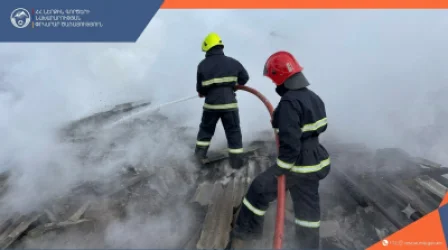
Երևանում 15-հարկանի կիսակառույց շենքում հրդեհ է բռնկվել

Ադրբեջանը կվերահսկի՞ հայկական ինտերնետը. մասնագետների պարզաբանումը

Մասկը կորցրել է տրիլիոնատիրոջ կարգավիճակը