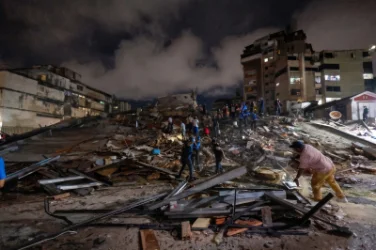
Turkey Must Withdraw from the Conflict Under International Pressure: Armen Sarkissian

The President of the Republic of Armenia, Armen Sarkissian, gave an interview to Sky News Arabia discussing the aggression unleashed by Azerbaijan and Turkey against Artsakh. This was reported by the Public Relations Department of the Office of the President of the Republic of Armenia.
The interview is presented below:
Question: Mr. President, can you present the roots and reasons of the conflict, and what is actually happening now?
Before starting the interview, I was looking at your program and the videos displayed. Allow me to start with a friendly gesture, as what you were showing were videos from the Azerbaijani side, and there were no videos from Nagorno-Karabakh, from the Armenian side. Please accept this as a minor observation.
You ask about the reasons; however, I believe that this question should be addressed to the President of Azerbaijan, as it is Azerbaijan that started this war. I can call this a war because in the last 26 years, while negotiations on the future of Nagorno-Karabakh were conducted between Azerbaijan and Armenia under the auspices of the OSCE Minsk Group, with the co-chairs being the US, Russia, and France, clashes did occur, but they were very localized. This is large-scale and has taken many lives.
Azerbaijan justifies, both officially and unofficially, that they were not satisfied with the negotiation process, which is why they started this, believing that they could solve the issue through force. My comment is the following: I do not believe that this conflict has a military resolution.
Of course, this conflict has become much more complicated with the involvement of a third party. The reality is that many people on both sides, including not only military personnel but also civilians, are being killed, as currently, Stepanakert and the villages are being shelled by the Azerbaijani side in Nagorno-Karabakh. This means that the situation is somewhat getting out of control. As I said, Turkey's involvement complicates the reality even more.
In the past, there was no direct involvement of a third party; negotiations were ongoing between Azerbaijan and the Republic of Nagorno-Karabakh and the Republic of Armenia, with negotiating parties trying to ease the conflict. However, now it has gained larger dimensions and become more entangled, especially with Turkey’s involvement as a third party.
Question: Mr. President, as you mentioned, the third party, Turkey, is clearly involved in the issue. Why is Turkey intervening, what does Mr. Erdogan want by sending Syrian mercenaries to the conflict zone?
Again, the question is not directed to me; just as the first question was directed to the President of Azerbaijan, regarding why the Azerbaijani president and the Azerbaijani side would start a war again. The addressee of your second question is also Mr. Erdogan, not me. However, I can present what I have heard.
We officially hear from here and there how the Turkish side claims that they are there to support their ethnic brothers. The Turkic ethnic brothers stretch from Anatolia to the East, Central Asia, Mongolia, and Northern China. Is Turkey planning to intervene every time there is a problem there? Sometimes they claim that supposedly there are PKK militants (in Nagorno-Karabakh), which is absolute nonsense. Instead, Turkey has brought not hundreds but thousands of mercenaries to Azerbaijan, most of whom are extremist jihadist terrorists. This raises concerns not only in Armenia, the Republic of Nagorno-Karabakh but also, I am sure, will cause concern in other countries in the region, including Russia, Central Asian countries, and so on.
The third claim made by the Turkish side again does not stand up to scrutiny. They claim that Armenians can shell important infrastructures, which in this case are energy infrastructures, oil pipelines stretching from Baku to Tbilisi and Ceyhan. That oil pipeline has been constructed for more than 20 years. If Armenians intended to shell it, they would have done so much earlier, even at the time when Azerbaijan was just thinking about its construction, preventing it from being built, thus perhaps not allowing Azerbaijan to earn billions of dollars over 20 years which were used to buy weapons and take lives of Armenians.
These are the officially declared reasons by Turkey for why they are involved. None of them is realistic. The real reason why Turkey is there is different.
Question: Mr. President, how do you assess the position of the international community regarding Turkey's intervention? You mention thousands of mercenaries from Syria that Turkey has brought to the conflict zone. Have you had phone conversations on this topic, for example, with the UN Security Council?
The international community is very broad, from the UN to NATO. Turkey is a member of NATO, and when Turkey signed to become a part of the organization, did that state sign a document allowing it to aggressively intervene as a third party in a conflict? Does that agreement allow them to bring mercenaries into the region? There are many organizations, from the European Union to the CSTO, of which Armenia is a member. All these options are on the table, and we are thinking of appealing to third parties or organizations.
But the issue is very simple. If the current war were only between Azerbaijan and the Republic of Nagorno-Karabakh, which for understandable reasons is supported by volunteers from Armenia and the Armenian people, it is very probable that, as always, international mediators or the member countries of the Minsk Group could stop this on the third, fourth, or fifth day. But due to Turkey's presence in Azerbaijan, all of this becomes much more complicated.
I think the international community should also be concerned, as, according to some commentators, Turkey is there with the aim of remaining. The question is whether the mercenaries or terrorists will remain there or will return after the war ends, which I personally do not believe. In fact, Turkey will control the oil pipeline that goes from the Caspian Sea to Europe, thereby putting everyone in dependency in terms of oil and gas supply from the Caspian region, including suppliers, Azerbaijan and Central Asia, as well as receivers. Perhaps this is Turkey's motive.
There is only one way to resolve the issue: Turkey must be removed from the conflict. Only then can there be hope for a ceasefire, followed by other steps.
Question: Mr. President, you said that the issue has no military solution. Do you think that the current conditions could lead to negotiations?
You spoke about two points; allow me to elaborate on both. Firstly, I do not believe, and there is no Armenian in the world who thinks that the conflict can be solved through force, especially after Turkey's involvement. Every Armenian and every friend of Armenians worldwide remembers that 105 years ago, Turkey committed a great crime called the Armenian Genocide. The Turks killed 1.5 million people and created the current Armenian diaspora from Argentina, the United States to Asia, Russia, and the Middle East. We in Armenia, Nagorno-Karabakh, and the Diaspora believe that the moment Turkey actively participated in Azerbaijan, all of this became another attempt at ethnic cleansing, another attempt at genocide. Any Armenian, no matter where they live, will not accept that. Armenians in Nagorno-Karabakh have always been an absolute majority. They will never accept that; they will fight to their death but will not allow it to happen. This is your answer to the first question.
I strongly believe that this issue does not have a military resolution. To the question, do I want or believe that there is a solution through peaceful negotiations, I will certainly answer yes: This issue can only be solved in one way: through negotiations. The model, the format is simple. Turkey must withdraw from this issue under the pressure of the international community, its friends, and sound reasoning, and at the moment when that happens, the problem will remain between Azerbaijan, Nagorno-Karabakh, and Armenia. I am convinced that the peace advocates in this region will exert pressure in that direction, and we will start negotiations step by step under the auspices of the OSCE Minsk Group, which is co-chaired by Russia, the United States, and France. There is only one solution: return to the negotiating table. However, first of all, Turkey must be excluded from this picture.
Question: Mr. President, as you mentioned, this mediation is carried out by France, Russia, and the US, but there are other countries proposing mediation, such as Iran, Georgia. How do you interpret such mediation proposals, and which one resonates more with you?
We are grateful to all those who express concern regarding everything happening in the South Caucasus. I want to express my sincere gratitude to all of them. Some are concerned because they live nearby. Some are worried because they understand that if these confrontations escalate and intensify, they may create great imbalance and problems throughout the Caucasus, and they do not want another Syria in the Caucasus. The issue in the region will involve everyone, and it would be sheer madness.
Thank you for all offers of mediation, negotiations, and mediations between the parties. In this context, the obvious strong mediators can be the countries that are already mediating as co-chairs of the Minsk Group: the United States, France, and Russia. I hope that these three mediators will raise their voices again and propose mediation. However, as I mentioned, these three countries that are members of the Minsk Group and their leaders will voice their concerns, not only calling for a ceasefire but also sending a message to Turkey that its role in this issue is entirely destabilizing and does not contribute to the establishment of peace. Turkey contributes to war and destabilization, as well as to the human losses on both sides. I believe that none of Turkey’s objectives and what it seeks in the Caucasus—presence, influence in the energy sector—is worth the lives of thousands of young people, elderly, and children that we lose every day.
Question: Mr. President, can you outline the overall situation, the humanitarian situation, as there are reports and concerns that the region may become another Syria? Can you convey to the world the worries you have regarding a humanitarian disaster?
I would first like to note why you are not mentioning, showing the humanitarian crisis in Nagorno-Karabakh, when the capital Stepanakert, Shushi, and the villages are being bombarded, destroying them? I believe the humanitarian crisis is very grave. There are many affected by these bombardments, people have lost their homes, and are trying to find shelter. The humanitarian crisis is growing day by day. I am convinced that this will not only happen on the Armenian side but also on the Azerbaijani side. This is the most important reason that the bombardments and killings, the war must stop.
When I hear the information presented by the Azerbaijani side, in many cases it is just propaganda when they claim to have achieved great victories. There are strategic losses of human lives on both sides. In addition to all this, there is a humanitarian crisis. People are losing their lives, losing their children, parents. This is not a conflict, a war that is taking place on the border or front line.
My message to the international community is: talk to Turkey and all those who continue to supply the Azerbaijani side with military equipment. There is no need to mention the names of those countries, but in that way, they become part of the conflict. The less supplies and encouragement there are, and the sooner Turkey is pushed out, the more hope we will have for establishing a ceasefire through international pressures, and, in particular, through the co-chairs of the Minsk Group. After all this, there will also be hope for the resumption of negotiations. There is no reason in the world that can explain replacing negotiations with war. No one says that after 20 years, negotiations—successful or unsuccessful—should be stopped because one side or the other is not satisfied with the other. Normal negotiations require patience, building trust. If you are dissatisfied, you should communicate that to the co-chairs and those who have influence, not start a war. Every human life is very precious, and the loss of it is a great tragedy for both sides.
I call on Turkish officials to think about their involvement in Azerbaijan. I want to tell the international community that Armenians perceive this war in Nagorno-Karabakh as ethnic cleansing and a continuation of the unfinished genocide that occurred 105 years ago. I strongly believe that there is only one solution to this issue: negotiations. The Armenians of Nagorno-Karabakh, who have lived there for thousands of years—these proud mountain people—will never retreat. In the case of Azerbaijan, it is solely about territories; they want those territories without Armenians. You call it territorial integrity, self-determination, but it is about human lives, values, human lives that are at risk.
Thank you very much, Mr. President.
Նմանատիպ հոդվածներ
Ավելին Society բաժնից
Վենեսուելայի երկրաշարժից հետո կան վիրավոր և անհետ կորած հայեր
Ֆրանսիայում ռեկորդային շոգի պատճառով ատոմակայաններ են կանգնեցվում
Անահիտ Մանասյանն ընդունել է Անդրանիկ Թևանյանի իրավունքներին առնչվող հարցերը բարձրաձայնող անձանց