Yerevan State University Faculty of Armenian Studies Expresses Distrust in Working Group for Programs and Standards
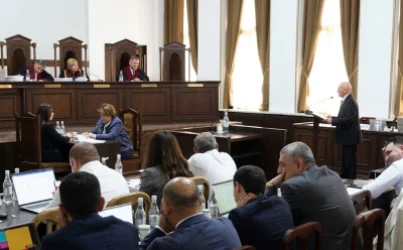
Discussions are currently taking place regarding the state subject standards and programs for "Armenian Language for Grades 7-12" and "Literature for Grades 7-12" in general education. Numerous Armenian scholars, including lecturers from the Faculty of Armenian Studies at Yerevan State University (YSU), have voiced their opinions. The matter was also discussed during a session of the faculty's scientific council. This information has been reported by the faculty.
Considering the supposed content changes made to the draft, the Faculty of Armenian Studies expresses its deep concern regarding these programs and standards, as well as its distrust in the working group, and unequivocally rejects the programs for substantiated reasons.
“In social media platforms, the authorship group, along with the Ministry of Education, Science, Culture and Sports has officially informed that changes are being made to the draft that was publicly announced (as described by the group members), and soon the revised and polished standards and program will be presented to the public. However, as expected from a group composed merely of those skilled in drafting during a nine-month period, a second revised draft was presented with only partially changed program for 'Literature',” the statement says.
It is already evident that the authorship group either does not wish to or is unable to respond to the significant majority of public demands. Moreover, without diversified professional discussions, there appears to be an effort to compartmentalize scholars with undeniable contributions to Armenian studies into false dichotomies of old and new through an inappropriate local adaptation of standards based on inadequate translations.
The Faculty of Armenian Studies at YSU, refraining from engaging in such discussions, presents several justified reasons for rejecting the programs:
A) The Literature project is entirely objectionable for the following reasons:
- For over a century, since the period of the First Republic of Armenia (1918-1920) to the present day, schools in Armenia have taught "Armenian Literature." In middle schools, students learned the subject "Literature," which included masterpieces of world literature. In high schools (previously in grades 9-10 and lately in grades 10-12), the subject was named "Armenian Literature," encompassing only significant authors and their selected works from classical Armenian literature. The current project proposes to remove the word "Armenian" from the subject name and correspondingly include works of world literature. This reduces the scope and time allocated to Armenian literature, diminishes the depth of teaching, and dilutes Armenian literature within incomplete world literature; the inclusion of works by a few European and American authors cannot present itself as world literature without Eastern and Russian literature. With these programs and standards, the subject "Armenian Literature" as a purposeful component of school education is effectively eliminated, which diminishes and distorts the national content of education, contradicting both the internal and external policies of a country at war and its overall strategy.
- Without any justification and rationale, the methodology of teaching literature in general educational institutions has fundamentally changed; the chronological method has been replaced by a genre-based teaching approach, which is unacceptable.
- In grades 7-12, students will engage in the same analysis of Armenian and foreign literature for five consecutive years, comparing poetry, drama, and prose works, revealing characteristics of language, style, imagery, vocabulary, and other textual features. In other words, they will not explore beyond the same frameworks.
- This change already prevents the inclusion of Armenian ancient and medieval literature, which does not conform to the aforementioned genre-based division. Therefore, the statement claiming this issue has been rectified is unfounded under the current system.
- The chronological method allows for the preservation of national memory, expressed through history and literature, while the proposed system mixes times and nationalities. Whether intentionally or inadvertently, it eliminates the distinction between nations with ancient civilizations and newer ones, neutralizing the contribution of the ancients to the history of global culture. The high value of our historiography from the 5th century is largely due to the fact that it was created in the 5th century and not in the 15th century, when many contemporary nations and states were still non-existent.
- It is fundamentally mistaken to assert that this somehow desires to turn high school into a faculty of literature. School and university programs have entirely different depths of teaching. Isn’t it clear that university programs assume a deeper professional grasp of 5th-century literature and medieval lyrical poetry, previously manifesting in the distinction of historiographical and artistic depiction’s specifics?
- Most importantly, the new standards do not allow for the creation of a comprehensive understanding of any author. For example, Tumanyan’s “Parvana” and “The Exploration of Tmokaberd” are meant to be studied in 8th grade, “David of Sassoun” in 9th, “Anush” in 10th, and “The Quatrains” in 11th. Similarly for other authors. No author is presented in their full portrait.
- This confusion has a single justification: to educate an independently thinking, self-aware, analytical, logically reasoning, and generally socially active individual. This is certainly good, but why in this manner?
- The standards are formulated in vague and awkward language, with definitions that repeat from class to class. There are inappropriate uses of literary terminology (“text within a text,” “intertextuality,” “narrator,” etc.) that bring the program closer to university-level courses in literary studies.
- The lists compiled from Armenian and world literature are very incomplete, mixed, and of poor quality. Their selection criteria are absent. It is evident that the works selected are not the result of a comprehensive professional evaluation but merely the preferences of a committed group, their momentary impressions, and an aimless aspiration to shape world citizens instead of Armenian citizens.
- Inclusion of contemporary writers and literature in the programs is positive. It is important to connect students with living literature and acknowledge contemporary writers. However, this is perhaps the most complex issue in two senses: First, to include new writers in the programs, it will necessitate reducing classical representatives, which will become an unavoidable necessity sooner or later. Secondly, new entrants should be worthy enough to replace old ones or at least occupy a position beside them. Furthermore, incorporating new authors requires taking into account the opinions of writers’ unions, literary scholars, and certainly their literary values. New names can find their place in middle schools, literary clubs, and extracurricular readings.
- Only minimal parts of the significant segment of Armenian classical literature—the diaspora Armenian literature—are presented in the program. This is a severe blow to the ideas of unity among our people and our homeland-diaspora.
- Teachers are given unmanageable freedom; they can choose and present works by Armenian and foreign authors at their discretion. What if a teacher and student choose only foreign authors based on their taste, and the best works of Armenian writers are left out? How will knowledge checks be organized in the final classes, and what framework of freely given knowledge will be mandatory for verification?
- The members of the committee present as their main argument for their "reforms" the reasoning that with the new standards, children are not to read well-known analyses, learn and then repeat them; instead, they should be able to conduct independent analyses. It is interesting—why should independent analytical skills be applied solely to literature? Isn’t literature that easy or subjective? Then why wouldn’t there be a science of literature? It is the same as allowing students to independently analyze and interpret episodes of Armenian history arbitrarily. This series can be continued endlessly. On the contrary, the teaching of literature must be based on serious scientific foundations, guiding the students to explain the role of certain authors in the development of our national literature and artistic thought. How can a child know what crucial role Kh. Abovyan's “Wound of Armenia” played in the formation and development of our new literature and how it influenced many different generations of subsequent Armenian writers if the textbook doesn’t guide them? It is also necessary to convey undeniable truths that students must first learn and then interpret independently.
- There is a saying from the scriptures that Hrant Matevosyan also uses, that first cultures lose, and then states. The proposed project-program is a program that leads to defeat. What a strong state, say the USA, can allow does not apply to a small population (not a small one, let it not be misunderstood) for whom culture, especially education, has strategic and nation-preserving significance. Thus, the significant exclusion of many Armenian classics from the programs and the removal of the word "Armenian" from Armenian literature greatly damages national interests.
B) The Armenian Language project is objectionable for the following reasons:
- The justification of the project's relevance is unfounded (we will not discuss the inaccuracies of word formation). “In the modern world, the rapid development of technology and science presents new challenges for education. Numerous professions that are in vogue today will soon be replaced by the work of machines and robots. This is why education in the Armenian (native) language and literature in general education schools also requires substantial changes.” Language is an absolute value and will exist regardless of whether professions are in demand or fading.
- The draft has distorted the role of language either knowingly or unknowingly. Language is not only a means of thought but also, first and foremost, a means of shaping national thinking, a crucial component of national identity, and a tool for creating national-patriotic character. This idea should have been at the foundation of the standards, while it is not expressed at all in this project. The Armenian language in the Armenian general education system should be taught based on this premise.
- The concept of the so-called tri-dimensional educational system is a questionable “innovation.” The term concept has been added. There is a transition from the previous format of knowledge-skill to a new format of concept-knowledge-skill/ability. But isn’t any knowledge presentation, recognition, and mastery started with interpreting concepts?
- The representation of the Armenian language and literature methodologies under the same standards and justifications is unacceptable. Armenian language and Armenian literature are different subjects (and are studied in different scientific disciplines), and consequently, their teaching objectives and methods also differ to some extent. The Armenian language should be described and presented as a separate subject. However, it is clear that the Armenian language and literature projects have been crafted nearly based on the same principles and exhibit some commonalities with the projects of exact sciences. It is understandable that certain tools for adapting to international educational programs have been applied, but they have been used incorrectly and inappropriately. Despite their commonalities, these are significantly different subjects, and the standards should not only differ sharply in content but also in the definitions of final outcomes and goals.
- The foundational idea of the project is flawed in that “the main goal of studying the Armenian language and literature is to teach spoken and written speech construction and text creation.”
- It is noted that a student should collaboratively create lesson planning with the teacher based on their interests. This is a highly debatable requirement. The interests of children aged 12-17, their perceptions and understandings of value systems are unlikely to align perfectly with programmatic demands; at that age and still on the path of acquiring new knowledge, students certainly cannot fully recognize and value the importance of grammar or stylistics, for instance. This is a general education program, and the guiding elements are primarily the standards, the textbook, and the teacher.
- The linguistic-content aspect of the project is lacking; the project does not provide sufficient knowledge regarding the Armenian language. The ultimate goal—that of mastering both written and spoken communication—if deemed “noble,” still requires an adequate foundation in linguistic knowledge for students to communicate articulately and construct impactful speech and develop creative thinking. This program addresses this issue only partially.
- Numerous topics are either missing or poorly represented, including the following: • The phonological system of language is not merely spelling and pronunciation. Previous years (up to grade 7) of taught material are insufficient. Topics of sound, stress, syllable, phoneme, and assimilation must also be presented comprehensively in middle school, then more deeply in high school. Teaching about phonological phenomena is vitally important for constructing grammatically correct, fluent, and aesthetically pleasing speech. • Vocabulary is poorly described or unclear among the critical divisions of the language. The project introduced a peculiar expression stating one of the three levels of language is not vocabulary but word formation (“Linguistic system—phonological, word-formational, grammatical systems of Armenian”). As a result, in the 5-6 years of the educational program, vocabulary (semantics, word formation, lexicon, phraseology, lexicography) is presented in bits and pieces. • The program does not foresee teaching verb gender, while the material is extremely significant—for understanding the functional possibilities of the verb system and orientation in syntactical structures so that one can construct expressive and purposeful speech accurately. • There is too little time allocated for teaching irregular and defective verbs—only 6 hours. This is among the essential topics of the verb system (wrongly displaced from the previous program). Mastery of this topic may even measure one’s literacy. The topic should be introduced in middle school, then taught in greater detail in high school. • The proportion of topics is not preserved; the importance and complexity of topics has not been taken into account—for instance, conjunction and connection are allocated only 4-5 hours each, the gerund only 8 hours, irregular and defective verbs 6 hours (7th grade), imagery and expressive means only 4 hours (11th grade). Meanwhile, certain topics are unnecessarily amplified, with excessive time allocated to some themes: special and common nouns, proper and demonstrative nouns—10 hours (7th grade), quoted direct speech—28 hours (9th grade), spelling—18 hours (10th grade), etc. • The portrayal of stylistics (as per the project, “STYLES”) has failed. This section of the program is composed with exceptional ignorance. It is unacceptable to differentiate functional styles from one another in the programmatic “decision.” They, despite their differences, share significant similarities and hence should be taught in a progressive unity.
- It should be particularly emphasized and highlighted the importance and role of practical work. The program “focused” on composing texts and documents and writing essays (literary texts), but that is by no means the proper path to cultivate creative thinking, especially when techniques for structuring essays and compositions are not explained. It is also a hidden path to profound material absorption—since, according to the authors' explanations, in certain classes students will compose “literary texts” concerning the works of selected authors with the teacher's help. However, in the final grade, knowledge checks necessitate prepared and polished “literary texts” composed by heart.
- The representation of interdisciplinary connections—the frequently directly copied similar documents from the West—is more formal in nature. This becomes especially evident in the final outcomes and sometimes practical task formulations. Particularly, the latter display evident professional serious deficiencies and omissions.
- The form of knowledge verification presented for the 12th grade is fundamentally unacceptable; verifying knowledge through essays will lead to arbitrary choices and subjective approaches.
- This document, to put it mildly, is not an exemplary illustration of a well-crafted essay (nine months was not insufficient time for a well-articulated and grammatically correct composition). It contains numerous incorrect formulations, fallacies, confused terminologies, and typos. Let's suffice to mention one or two examples: “Standards are shaped considering the individual characteristics of learners…” (Are the requirements considering something?); “The rapid development of technology and science…”; “The Armenian language's grammar is studied…”—is the grammar emphasizing something? “For the education of the Armenian language, the following basic and sub-concept terms are set…” “Linguistic grammar?” and so on.
It is regrettable that the Ministry of Education, Science, Culture and Sports presents this kind of documentation to the public.
Նմանատիպ հոդվածներ
National Security Service Opens Criminal Case Regarding Narek Sardarayan's Incident in Azerbaijan
MP Hayk Sargsyan's Friend Illegally Exploits 'White Shorja' Recreation Area
Caretaker Changes Disinfection Rules for Gyms and Swimming Pools
Hayk Sirun Chich: Thick-trunk Trees of Mashtots Park Cut Down, Armen Begoyan
Ավելին Society բաժնից

Հուլիսի 2-ից եղանակը կփոխվի․ հայտնի է՝ ինչ է սպասվում

Այս նախագիծը սխալ է․ Սամվել Մարտիրոսյանը չի պատրաստվում նահանջել IMEI-ի հարցում

ԵՄ-ում նոր հարված են պատրաստում Ռուսաստանին․ պահանջում են ամբողջությամբ արգելել ռուսական նավթի ներմուծումը