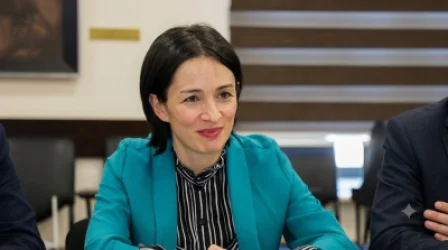
President and Anahit Bakhshyan Discuss Concerns Over Lanzarote Convention

President Armen Sarkissian welcomed education expert Anahit Bakhshyan, who had addressed a letter to the president to express her concerns regarding the Lanzarote Convention ratified by the National Assembly.
Before addressing the main topic, President Armen Sarkissian once again referenced the coronavirus pandemic, urging citizens to remain vigilant and adhere to all necessary regulations.
“I feel obliged to use this opportunity to once again call upon all our compatriots to observe all social distancing rules. I do not want any of our compatriots to think that if 10 or fewer people are dying daily, it can be considered normal life. This is not normal life. This is a tremendous tragedy,” stated the president. “Imagine 5, 10, 15 families losing their loved ones. I also want to take this opportunity to express my condolences to them. We must be very careful, principled, and disciplined, doing everything required of us and more.”
The president also expressed his gratitude to doctors for their heavy workload and dedication. “I want to once again thank our doctors. Regardless of what is happening, we know today that doctors are working day and night, putting their lives and those of their families at risk. Hospitals must be treated as bastions of health, fortresses. I extend my deep gratitude to all doctors, from chief physicians to on-duty doctors, nurses, and guards. You are our heroes today.”
Regarding Ms. Bakhshyan’s concerns about the Lanzarote Convention, President Sarkissian first noted that he himself has worries. Addressing the question of whether he would sign the convention, the president explained the legal process, indicating that after ratification by the National Assembly, the president does not receive the convention itself but the law adopted by the National Assembly regarding its ratification. He has very limited powers; the first is to appeal to the Constitutional Court if he believes there is a contradiction with the Constitution. However, considering that the Constitutional Court has already stated there is no contradiction, the president has the second option—to sign. If the president does not sign, it will be signed by the Speaker of the National Assembly within a few days and come into force.
“You may view the convention as international law or a declaration of principles. However, each of the 47 countries that signed the convention has the right to exclude certain points when ratifying it. In our case, our National Assembly did not exclude certain points, so the convention is as it is. After adopting the convention, any country accepts it as a principle. However, there is a huge gap from principle to implementation,” the president clarified. “I am interested in what will happen 10 months or 10 years from now. I share everyone’s concerns. I think the most important question is whether we will have, as in the past, certain emotional expressions and calls in some cases, and after a few days forget—without discussions on further steps. This truly needs the attention of our entire nation. This concerns our children, their health, protection, and education. I not only share your concerns but I can say my concern is greater.”
The president noted that various countries choose different ways to apply the convention. Each country has the right to interpret and apply principles in its own way. Some countries trial application in a few schools, others involve parents in the process, and some countries start education at different ages.
According to President Sarkissian, although universal principles are the same, there are national and cultural peculiarities that each country considers while applying the convention. He regarded the ratification of the convention only as the beginning of the process, which should be followed by public discussions regarding the adoption of necessary laws that, considering our national values, should set necessary regulations, answering several essential questions.
“There are several fundamental issues. First of all, the issues relating to violence and its elimination—this is a sensitive issue. Our culture is such that people often prefer to hide it. But even if they do not hide it, if a child has been subjected to violence, which is a great tragedy, we must be very cautious throughout the process. If a certain legal process is initiated as a result of that violence, mechanisms must be established so that the child is not subjected to additional stress. Therefore, apart from eliminating violence, we need laws, rules, mechanisms, so that the child does not experience all of it. Thus, we have enormous problems related to violence that we still need to solve,” the president emphasized.
The president highlighted the crucial principles in the field of education that must be established in the future. “First, who is teaching? It is no secret that sometimes the same teacher teaches several subjects. The teacher must present the very values we want to be conveyed. If the teacher does not present those values, they will cause more harm than good. The second question is what we are teaching. This is very essential, and we need laws, appropriate textbooks, programs, to retrain the teaching staff. This will not happen overnight; it is a colossal task. Otherwise, you cannot allow anyone, even the highest qualified, to enter schools without certain standards. And it is also critical how we are teaching. Moreover, that teaching often must be individualized. The learning process requires enormous work. The role and opinion of parents are very important. The convention clearly states about parents' roles, and parents have the right to express their opinions. There are countries that have decided that the best form of education is with parental involvement. And finally, education must be individualized, taking into account each child’s and their family’s particularities, as we can both harm and help that child,” he mentioned.
We are in a situation where we have had neither public discussions on all these issues nor concrete proposals; some politicians have expressed positive opinions, but all of this must be systematized, become law, and form an educational program. To answer these crucial questions, the president emphasized the importance of conducting public discussions and the need for continuous attention to the issue from all interested parties and individuals.
“My entire concern is that our energy does not go solely into voicing opinions, leaving no energy to educate and protect our children, and to develop the necessary regulations,” emphasized the president. “If people say that in any other country where this convention is accepted, they will not base it on their national values, they are mistaken. First and foremost, we must define our national and family values. And then say, very well, in the 21st century, these values will somehow change, be redefined. We differ from other countries.”
President Sarkissian suggested to Ms. Bakhshyan and all individuals, organizations, who are concerned, to start a public discussion. “The real path today is not the end of this issue. Many of our compatriots think that today is the end; it is signed, and that’s it. Today is the beginning of this process—to show who among us is genuinely concerned about the education and protection of our children,” he stressed. “For every law, we must demand there be a public discussion—open, participatory, and here I am your ally. Whether I am president or not, I am your ally and will follow this. I am the ally of you, that is, of our nation. No one has the right to treat this process lightly. We have values that must be preserved at all costs.”
Նմանատիպ հոդվածներ
Ավելին Society բաժնից
Հայաստանի անտառներում տեղադրվում է արջերի մասին զգուշացնող վահանակներ
Քիմիայի քննության շուրջ բողոքը հասել է վարչապետին
Ոչ թե ճիշտ էր, այլ չափազանց անորոշ․ Քոչարյանի թիմը՝ Ալեն Սիմոնյանի գործով վճռի մասին