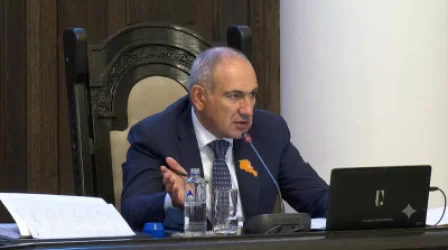
VIDEO: Pashinyan's Speech at the UN
During his working visit to New York, Prime Minister Nikol Pashinyan delivered a speech at the UN Headquarters as part of the 74th session of the UN General Assembly. Below is the full text of the Armenian Prime Minister's address.
“Mr. President, Your Excellencies, Ladies and Gentlemen,
At the outset of my speech, I would like to congratulate H.E. Tijjani Muhammad-Bande on his election as President of the UN General Assembly. Mr. President, I would like to assure you of Armenia's full support during the 74th session of the General Assembly. I also wish to express my deep gratitude to the President of the 73rd session, Madam Maria Fernanda Espinosa, for her active leadership and for the valuable legacy we have received.
This is my second opportunity to present my country at this high body in the capacity of Prime Minister of Armenia. Since my last statement at the UN General Assembly, our country has undergone tremendous changes. Last December, extraordinary parliamentary elections were held in Armenia. For the first time in about 25 years, the elections held in Armenia were not contested by any political party. They received the best assessments from international observers who welcomed the elections as free, fair, and transparent. This was one of the most significant achievements of the peaceful Velvet Revolution of 2018.
As a result of the events last year, international media referred to Armenia as a global beacon of democracy. Recognizing our democratic achievements, The Economist declared Armenia as the country of the year.
We have an unwavering determination to advance democracy and reforms in our country. This is based on the overwhelming mandate given by our people, for which we are responsible for implementing reforms, ensuring justice, improving economic and social conditions, and developing our nation.
There exists some resistance to democratic reforms domestically from the former corrupt elite that seeks to obstruct the new government’s zero tolerance policy against corruption. They attempt to evade justice using their financial resources and challenging our democratic achievements and the democratically elected government of Armenia which has not carried out any redistribution of property and ownership.
Our media are fully free from government control or interference. However, some of them are subject to the same old frameworks of the previous government, fabricating fake news and sowing distrust in society regarding the origins and goals of the Velvet Revolution. Despite this challenge, our determination to promote and protect media freedom is unwavering.
Doubts have been expressed about the nature and goals of our revolution. Some believed that this revolution was instigated by global rivals opposing us in our region. Others questioned if they weren’t behind this revolution, then who else could have done so?
From this high podium, I want to reiterate once again that the Velvet Revolution in Armenia was carried out by its proud citizens as an expression of their will to reject corruption, abuse of power, monopolization of economic and political power, continuous electoral fraud, and political manipulation. The expression of the will of the Armenian people should not be viewed from the perspective of the rivalry of global powers, as they are the ultimate sovereigns in our country.
The political transformations aimed at realizing the dream of having a free, democratic, and happy country—a dream born in the late 1980s at the twilight of the Cold War that has brought independence to our people.
Ladies and gentlemen, the Armenian non-violent Velvet Revolution has proven that democratic changes are possible in the modern world. But the revolution was only the beginning of our mission and perhaps the easiest phase of it. We are currently in another phase of our mission, one that is more significant and challenging. We must demonstrate that democratic transformation in Armenia is irreversible.
We are proud that we already have certain results. Our economy is growing steadily and fairly rapidly. The growth was facilitated by a significant ideological transformation that took place in our country. The individual effort of each citizen matters: this idea is the main driving force of our economic revolution. And our government’s most important mission is to inspire and convince our citizens to believe in their talent and their ability to bring about real change.
Individual efforts have been the main formula for the success of our political revolution. Before the revolution, only a small number of people believed that individual efforts could bring about political change in our country. But today, this is an imperative idea for the overwhelming majority of the citizens of the Republic of Armenia. Consequently, our shared goal is to implement the economic revolution precisely along the same path that the political revolution has previously followed.
Reforms and institutional development are powerful tools that we must employ to address the challenges facing democratic Armenia. Immediately after coming into power, we initiated an unprecedented package of radical measures aimed at creating democratic institutions. These include, for example, efforts towards creating a level playing field for all economic and political players and independent judicial, anti-corruption bodies. Empowerment of women is another area where we have taken bold steps to achieve visible results.
The most important direction of our institutional reforms is education. We believe that only by promoting education can we make democracy irreversible and achieve sustainable economic growth. Our vision is to make lifelong education a nationwide practice for all strata of our society—from children to adults.
The Government of Armenia is determined to continue institutional reforms, but we also hope that the international community will support Armenia’s budding democracy to face the challenges ahead. We need to reach international best practices to save time and resources. We must avoid the mistakes made by other nascent democracies in order to make our democratic reforms more effective.
Taking this opportunity, I would like to thank our international partners who are truly committed to supporting our reform agenda. In particular, we are grateful to the UN Development Program, the European Union, and the Council of Europe. In essence, I mentioned the UN, our global organization that encompasses nearly the entire international community, and I hope all members of the international community would like to see Armenian democracy succeed.
Dear Ladies and Gentlemen, unfortunately, our planet has not become a safer place for all of us this year. It is difficult to find any region of the world that has not itself been destabilized or affected by tensions in neighboring regions. Two of Armenia's four borders, including the border with Turkey, have been closed for nearly three decades. By refusing to establish diplomatic relations with Armenia and supporting Azerbaijan against Armenia and Nagorno-Karabakh, Turkey continues to pose a serious threat to the security of the Armenian people, who have already been victims of genocide and witnesses to the denial of historical truth and fierce resistance.
Mr. President, the existing tensions in the relations between our neighbors and strategic partners put us in a very awkward situation. Russia is our main strategic partner and ally, while Georgia and Iran are our strategic neighbors. We have a strategic agenda and partnership relations with the USA, the European Union, and its member states. It is a serious challenge for us to get caught in the crossfire of disagreements among our partners as we are constantly at risk of being misunderstood by some or, worse, by all.
We are doing everything we can to be a reliable partner and a good friend to all without harming our relations with anyone. And we will continue to work to make the geopolitical environment of our region safer.
Ladies and Gentlemen, the peaceful resolution of the Nagorno-Karabakh conflict is crucial to the stability and security of our region. From the very first day of my tenure, I have taken steps in this context. To this end, I articulated a statement that any solution to the Nagorno-Karabakh conflict must be acceptable to the peoples of Armenia, Nagorno-Karabakh, and Azerbaijan.
Significantly, I was the first Armenian leader who expressed such a position regarding the resolution of the conflict. I was harshly criticized in my country for proposing a formula for a solution that equates the three parties to the conflict. Nevertheless, I believe this is the key to a peaceful resolution of the conflict, as it implies the possibility of compromise, mutual respect, and balance.
I presented this formula not only to the public but also in the framework of negotiations held under the auspices of the OSCE Minsk Group. To move forward, I expected such a statement from Azerbaijan as well. However, the Azerbaijani authorities maintained their position, seeking a resolution to the Karabakh issue that would only be acceptable to the people of Azerbaijan.
What does this really mean? It means that the Azerbaijani authorities have no intention of resolving this conflict. Instead, they want to defeat the people of Nagorno-Karabakh. They do not want to go for any compromise. Their goal is revenge for the aggression against the people of Nagorno-Karabakh in the 1990s and the failed attempt in 2016. That is why they incite anti-Armenian sentiments among their people, which is why they spend enormous resources on armament, and that is why hatred of Armenians has already become Azerbaijan’s official policy.
In fact, our adversaries want to restore the Soviet-era status of Nagorno-Karabakh. But this is a futile effort, as during the Soviet period, the people of the Autonomous Oblast of Nagorno-Karabakh declared their independence and exercised self-determination just as Azerbaijan did when it left the Soviet Union. Azerbaijan's position is tantamount to the idea of restoring the Soviet Union.
The Azerbaijani government presents the Nagorno-Karabakh conflict as a territorial dispute between Armenia and Azerbaijan. We do not agree at all with that interpretation of the conflict. This is not a dispute between Armenia and Azerbaijan. This is not about territorial claims. It is about people, the men, women, and their right to live in their homeland, just as they have lived for centuries.
Sadly, the Azerbaijani authorities do not want to talk to those people and negotiate with them as they want to have territories but not people. More precisely, territories without people.
Ladies and Gentlemen, I find it essential to explain why I am addressing this topic. It may seem as though I intend to contribute to rising tensions in the region. Of course not, on the contrary, I want to say that the Nagorno-Karabakh conflict is a very complex and painful issue for the peoples of the region that cannot be resolved without hard and systematic work, without compromise, mutual respect, and a balanced approach.
Therefore, I call upon my colleague, President Ilham Aliyev, to adopt the formula to create conditions for progress in the peaceful process. Any resolution to the Nagorno-Karabakh conflict must be acceptable to the peoples of Armenia, Nagorno-Karabakh, and Azerbaijan. We must work together to turn this formula into reality.
Ladies and Gentlemen, a few days ago we celebrated Armenia's Independence Day. 28 years ago, Armenia became a full-fledged member of the international community as a sovereign state, restoring its place and role in the global arena.
We are a stakeholder in international cooperation and at the same time a contributor to the agenda of security, development, and human rights. We attach great importance to effective multilateralism. We are working with all our partners at both international and regional levels to promote global security, combat international terrorism, prevent the proliferation of nuclear weapons, ensure nuclear security, and conduct peacekeeping operations.
Armenia participates in peacekeeping operations in Mali, Lebanon, Kosovo, and Afghanistan and conducts humanitarian missions in providing medical assistance and demining operations.
The benefits of effective multilateralism are reflected in the global efforts aimed at achieving the Sustainable Development Goals. The process of nationalizing the Sustainable Development Goals in Armenia is complemented by the launch of an ambitious transformation strategy scheduled until 2050, which includes 16 mega-objectives. The priorities of education, innovation, and smart development emphasize the interconnectedness between development and human rights. The role of women and youth in furthering progress is essential for Armenia.
We will continue to focus on all of these issues both domestically and on the international agenda. I would also like to emphasize the integration of economic and environmental policies. Armenia is already feeling the negative impact of climate change, recording an average temperature rise of 1.3 degrees. To address this global challenge, we are working on developing innovative mechanisms for climate financing that is part of Armenia's national commitment made at the Climate Action Summit held under the auspices of the Secretary-General.
Sustainable development and the protection of human rights must be an inclusive process. It should be accessible to all, regardless of their political status and geographical situation. No one, including the people of Nagorno-Karabakh, should be excluded from the tools for sustainable development. Like others, Nagorno-Karabakh should receive international financial and technical support to strengthen human rights, overcome poverty, improve education, respond to climate changes, and build an inclusive society.
As a democratic country and a reliable and predictable member of the international community, Armenia will continue to contribute to international cooperation for the maintenance of global peace and security, promotion of sustainable development, and protection of human rights and fundamental freedoms. We are committed to continuing constructive dialogue with all international partners to collectively address universal challenges and ensure progress and prosperity for our peoples.
We are against dividing lines and confrontation policies. We are against closed borders, which are deemed absurd in the 21st century, yet still exist in our region.
As a nation that has gone through the horrors of genocide, we stand for understanding and peace in our volatile region. A policy based on unrealistic hopes of military superiority and an arms race has no future in the South Caucasus.
The peoples of our region deserve to live freely and peacefully, to create good, nurture their children, and build a bright future.
Thank you for your attention.”
Նմանատիպ հոդվածներ
Clarification: Foreigners Must Have Residence Documents Only When Driving in Armenia
Live: Money is Becoming Cheaper for Armenian Citizens, Dear Fellow Countrymen - Nikol Pashinyan
Exclusive Video: Vazgen Sargsyan Discusses Levon Ter-Petrosyan's Non-Public Political Moves on Nagorno-Karabakh
Armenians Do Not Cut Off People's Heads: Marukyan Responds to Azerbaijani Delegate at PACE
Ավելին Politics բաժնից
Վարորդական իրավունքների վերահսկողությունը կթվայնացվի. ՆԳՆ նախարար
ՏԵՍԱՆՅՈՒԹ. Երիտասարդ մայրիկներն ավելի շատ են աշխատում, դրա պատճառով մանկապարտեզների հերթերը մեծանում են. Փաշինյան
ՀՀ-ում ընտրված պաշտոնյան պետք է ծառայի միայն Հայաստանի Հանրապետությանը․ Արուսյակ Ջուլհակյան