What Attracts Armenia to Indian Defense Industry? "Hetq"
On September 29, 2022, during a Cabinet meeting, Prime Minister Nikol Pashinyan stated that there are cases where hundreds of millions of dollars have been paid, but military supply commitments towards Armenia are not being fulfilled, including by allied countries. Essentially, Pashinyan was primarily referring to Armenia's number one military supplier, Russia. "In all directions, in all cases where possible, unfortunately, they (referring to Azerbaijan) have certain successes also in terms of relations with our allies. Where possible, they try to do everything so that Armenia does not receive weapons and military supplies," Pashinyan declared during that session.
This was not the beginning of the issue; Pashinyan’s comments pertained to a broader time span, but the conversations and reports about Armenian-Indian military-technical cooperation gained momentum following the Azerbaijani military aggression on September 13-14, 2022.
“Swathi” Radars
According to publicly available data, Armenia ordered weapons from India for the first time in 2020. This concerned the "Swathi" anti-mortar radars, used to identify enemy artillery positions and detect fired shells. Based on the data from the Stockholm International Peace Research Institute (SIPRI), which specializes in weapons trade statistics and research, Armenia received its 4 ordered radars in 2021. The transaction was valued at 40 million dollars. Indian "The Economic Times" also reported that the price of the deal was 3.5 billion rupees or about 43 million dollars.
Defense expert Leonid Nersisyan tells "Hetq" that the officially stated technical specifications of the Indian radar are quite good. According to open sources, the radar detects mortars located at distances of 2-20 km, artillery pieces at 2-30 km, and launch stations for unguided missiles at distances of 4 to 60-80 km. Nersisyan notes that if we compare "Swathi" with the Russian "Zoopark", the former is quite compact, whereas the Russian system consists of several vehicles, is slower, and thus easier to target compared to the Indian one. Additionally, "Swathi" is not complex in terms of usability.
"The Economic Times" reported that "Swathi" radars have been successfully used by the Indian army along its borders with Pakistan and China. "Indian technology is advantageous given that the theater of military operations includes mountainous terrain, which is more challenging than the elevations found in Armenia – above 5 km, like in the Himalayas," Nersisyan emphasizes, adding that the Indian defense industry, based on its country's geography, focuses on mountainous terrains, which is also suitable for Armenia.
“Pinaka” Multi-Barrel Rocket Systems
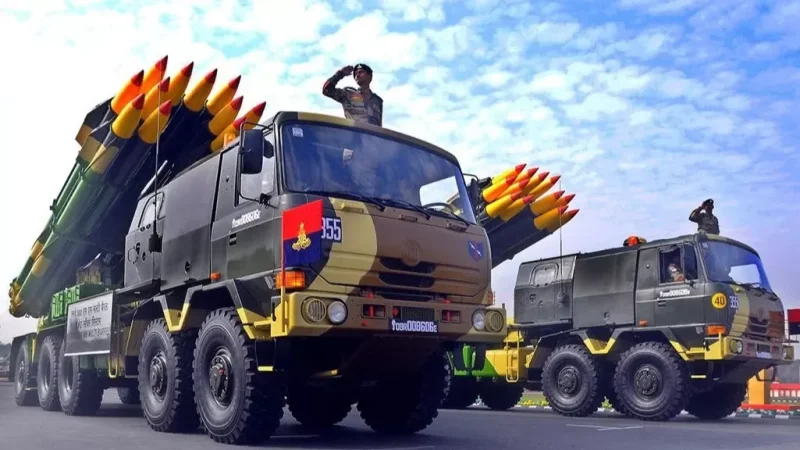
Regarding these systems, "Hetq" reported in September 2022, citing Indian "The Economic Times". According to the Indian press, "Pinaka" systems are to be delivered to Armenia, replacing the Russian "Grad" in India. According to information based on Armenian-Indian agreements valued at over 20 billion rupees or about 245 million dollars, the Indian side is expected to deliver "Pinaka" multi-barrel rocket systems (MBRS), anti-tank missiles, and a range of ammunition to Armenia in the coming months.
The design of "Pinaka" began in India in the 1980s, aimed at replacing the Soviet/Russian "Grad" MBRS. It was planned that from 1994 onwards, the Indian army would be replenished with one battery of "Pinaka" annually. Each battery includes 3 launchers, each containing 6 MBRS plus reserves. Thus, according to Indian standards, one battery of "Pinaka" comprises at least 18 launchers, in addition to support vehicles, radar and command post.
"The Economic Times" mentioned in September 2022 that Armenia has ordered 4 launchers of "Pinaka", with 2 to be delivered initially, followed by another 2 later. In terms of Indian standards, this means the Armenian army will receive 24 launchers and other systems.
"Pinaka" has variants with calibers of 122 mm and 214 mm, the first corresponding to the Soviet/Russian "Grad", while the second is closer to the Soviet/Russian "Uragan", whose caliber is 220 mm. Depending on the variant, the maximum range for "Pinaka" rockets spans from 37.5 to 75 km (for "Grad" it is indicated at 42 km, and for "Uragan" it is noted at 35 km). Test phase rockets for "Pinaka" have been noted to reach maximum ranges of up to 90 km.
According to "The Economic Times", Armenia is set to acquire "Pinaka" extended range (ER) and guided missiles. The range for guided missiles reaches 70 km; however, it remains unclear which specific extended range missiles are included, since "Pinaka" variants have "Mk-I" (37.5 km range) and "Mk-II" (60 km range) rockets, with plans for larger range variants like "Mk-I Enhanced" (45 km) and "Mk-II ER" (90 km, reportedly in the testing phase).
For additional details, refer to the source website.
Նմանատիպ հոդվածներ



Ավելին Military բաժնից
Իրավիճակը շարունակում է լարված մնալ. Իսրայելը հարվածել է Իրանի նավթաքիմիական համալիրներից մեկին

Իրանը հրթիռներ է արձակել Իսրայելի ուղղությամբ

Պուտինը` Զելենսկու բաց նամակի մասին