Pashinyan Explains Why He Did Not Sign CSTO Document on Armenia
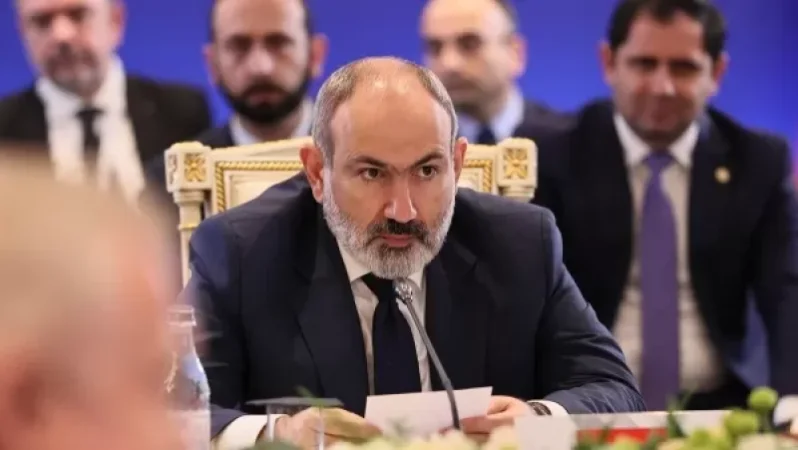
In Yerevan, a regular meeting of the CSTO Collective Security Council was held under the chairmanship of Prime Minister Nikol Pashinyan.
Pashinyan noted in his main speech: "It is fundamentally important for us to establish a zone of responsibility for the CSTO in the Republic of Armenia. The existence of such a formulation may seem strange, but after analyzing our recent discussions, we have come to the conclusion that it is extremely important. Our position is as follows: according to the Almaty Declaration of December 21, 1991, the founding countries of the CIS, as independent states, recognized each other's territorial integrity and the inviolability of existing borders. This means that the aforementioned countries became independent with the administrative borders that existed between the republics during the Soviet era. In other words, former administrative borders have become state borders, and the territories of the aforementioned countries are determined by these borders. It is on these borders that the Republic of Armenia became a member of the UN and the CSTO.
Since May 11, 2021, Azerbaijan has used armed forces three times and occupied about 140 square kilometers of the sovereign territory of the Republic of Armenia. This occurred on May 11 and November 14, 2021, and September 13, 2022. Thus, according to UN Resolution 3314 of December 14, 1974, Azerbaijan's aforementioned actions are considered aggression.
What do we expect from the CSTO in this regard? Documenting this fact in the form of a clearly formulated political assessment. Refraining from such an assessment by stating that there is no border between Armenia and Azerbaijan means asserting that there is no zone of responsibility for the Collective Security Treaty Organization, and if there is no zone of responsibility, then there is no organization. At least, that is one way to interpret it.
These nuances are important also because they play a decisive role in subsequent collective actions. In this context, I want to respond to comments claiming that Armenia is trying to draw CSTO countries into a war with Azerbaijan. This is simply manipulation, as Armenia cannot be interested in war, if only because it has suffered enough from wars, including this year's September war.
The political assessment of the aforementioned events is necessary primarily from a moral perspective, as it should be a logical manifestation of allied relations. Of course, this is also important for the restoration of our country's territorial integrity, but this aspiration itself does not imply military intervention. According to Article 3 of the CSTO Charter, political means are given priority in the collective defense of the territorial integrity of member states.
It is for this reason that Armenia also proposes to expedite through the decision of the CSTO Collective Security Council the necessary political and diplomatic work with the Azerbaijani side aimed at the immediate and unconditional withdrawal of Azerbaijani troops from the sovereign territory of the Republic of Armenia to their initial positions as of May 11, 2021.
This position is important not only for restoring the territorial integrity of the Republic of Armenia but also for deterring Azerbaijan from further aggressive actions against our country.
The ongoing threat of new aggression by Azerbaijan against the territorial integrity of Armenia was noted on October 28 of this year during an extraordinary meeting of the CSTO Collective Security Council by CSTO Secretary-General Stanislav Zas. In this context, the absence of a political assessment of the situation and the failure to make the aforementioned decision could signify not only a retreat from allied obligations by the CSTO but also be interpreted by Azerbaijan as a green light by the CSTO for further aggression against Armenia. And that contradicts not only the letter but also the spirit and meaning of the fundamental documents of the CSTO. Therefore, proceeding from this, dear colleagues, at this moment I believe that the submitted draft of the 'CSTO Collective Security Council Declaration and Joint Actions to Assist the Republic of Armenia' is not sufficiently finalized, and in this form, with all due respect, I am not ready to sign these documents.
Honorable leaders of the states,
Recently, there have been many comments on the history of the Nagorno-Karabakh issue. However, I do not wish to address the genre of historical excursus, not because I have nothing to say on this matter, but because an analysis of the current situation is more important today.
On November 9, 2020, with the efforts of the President of the Russian Federation Vladimir Putin, a trilateral statement by the leaders of Russia, Armenia, and Azerbaijan was adopted, followed by many documents, statements, and comments regarding the necessity of adhering to all points of the trilateral statement of November 9, 2020. This clearly means that not all points of the trilateral statement are being upheld, but it is not said who and which side is failing to comply with those points and agreements.
Today, I will attempt to summarize this issue as I must state that there has been no opportunity to speak on this matter as they say, in a bundled manner.
The first point of the trilateral statement states: 'A complete ceasefire and the cessation of all hostilities in the conflict zone of Nagorno-Karabakh is declared, effective from 00:00 Moscow time on November 10, 2020. The Republic of Azerbaijan and the Republic of Armenia, moving forward, hereinafter referred to as the Parties, cease to occupy their positions.'
The third point of the same statement states: 'A Russian peacekeeping force consisting of 1,960 servicemen armed with firearms, 90 armored personnel carriers, and 380 units of automotive and special equipment is deployed along the contact line in Nagorno-Karabakh and along the Lachin corridor.' This point clearly establishes that there is, there exists Nagorno-Karabakh, there exists a contact line in Nagorno-Karabakh, and there exists the Lachin corridor. A peacekeeping contingent is deployed along the contact line and Lachin corridor, forming a zone of responsibility for peacekeepers, and the parties remain in their positions, except for the Kelbajar, Agdam, and Lachin districts, according to the second and sixth points of the statement.
By violating these points, Azerbaijan declares that Nagorno-Karabakh does not exist, contrary to a document signed by, among others, the President of Azerbaijan. By violating the ceasefire and all military operations, as well as the agreement of the parties to remain in their occupied positions, Azerbaijan has already occupied the villages of Khtsaberd and Hin Tagher in Nagorno-Karabakh illegally in December 2020, along with adjacent areas.
Azerbaijan has executed similar occupations also in March 2022, violating the contact line and invading the zone of responsibility of the Russian peacekeeping forces in Nagorno-Karabakh towards the village of Parukh. Azerbaijan continually violates the ceasefire regime, including along the contact line.
It should be noted that during the occupation of the village of Khtsaberd, in the presence of Russian peacekeepers, Azerbaijan took 66 Armenian servicemen prisoner, also in the presence of Russian peacekeepers. This means that both of these actions occurred in the presence of Russian peacekeepers.
By violating the eighth point of the November 9, 2020 statement, which states: 'Exchanges of prisoners of war, hostages, and other detained persons, as well as the bodies of the deceased, are carried out.', Azerbaijan has so far not returned to Armenia at least 33 prisoners of war, hostages, and other detained persons.
The sixth point of the November 9, 2020 statement states: 'The Lachin corridor (5 km wide), which ensures the connection of Nagorno-Karabakh with Armenia, while bypassing the city of Shushi, remains under the control of the peacekeeping forces of the Russian Federation.' To this day, the Lachin corridor is not fully under the control of the Russian peacekeeping group, and the Azerbaijani army maintains several positions in the Lachin corridor.
The ninth point of the November 9, 2020 statement states: 'All economic and transport links in the region are unblocked. The Republic of Armenia ensures the safety of transport communications between the western regions of the Republic of Azerbaijan and the Nakhchivan Autonomous Republic, in order to organize unhindered movement of citizens, vehicles, and cargo in both directions. Control over transport communications will be exercised by the bodies of the border service of the Federal Security Service of the Russian Federation. By mutual agreement of the parties, the construction of new transport communications connecting the Nakhchivan Autonomous Republic with the western regions of Azerbaijan will be ensured.' The President of Azerbaijan constantly claims that a corridor should be created through the territory of Armenia and blames Armenia for not fulfilling the above point. I specifically quoted the ninth point of the trilateral statement to show the obvious: there is no word 'corridor' there, nothing is said about the corridor.
This paragraph, as you were convinced, refers to the unblocking of all economic and transport links in the region, and only in this context is the transport link mentioned between the western regions of Azerbaijan and the Nakhchivan Autonomous Republic, and this part, accordingly, is part of the process of unblocking transport and economic communications in the region.
This is also evident from the January 11, 2021 trilateral statement, which clarifies the ninth paragraph of the November 9, 2020 trilateral statement, is a document elucidating the meaning of this paragraph. Accordingly, it should be noted that the accusations against Armenia concerning the violation of the ninth point of the November 9, 2020 statement are completely unfounded. In this regard, Armenia has only one obligation: to ensure the transport link between the western regions of Azerbaijan and the Nakhchivan Autonomous Republic, whereas no specific route is mentioned in the November 9 statement or any other statement.
The Republic of Armenia has always been and is now ready to ensure such communication, and for this purpose, a draft decision has been put into circulation regarding the establishment of checkpoints at the Armenian-Azerbaijani border, and as a result of this decision, Azerbaijan could obtain a connection to the Nakhchivan Autonomous Republic via Armenian routes. This decision is not being made for one reason only: Azerbaijan does not want this route. This means that Armenia is fully fulfilling its obligations, while Azerbaijan does not want to take advantage of the opportunity provided. Meanwhile, such a rejection is completely incomprehensible. If Azerbaijan truly desires peace and aims to achieve peace, as it claims, then let us open these checkpoints, these roads, let us create opportunities for people. It is understandable that at first, there may be hesitations and doubts, but once they are convinced of the sincerity of intentions, then both Armenian and Azerbaijani citizens will undoubtedly begin to benefit from this new transport opportunity, and I am confident that citizens from Russia and our other countries will too.
Regarding the construction of new roads, according to the November 9, 2020 trilateral statement, or any other statement or document, the Republic of Armenia has no such obligations. The ninth point of the statement provides such an opportunity with the consent of the parties. And the Republic of Armenia is ready to give its consent. But the agreement did not materialize for only one reason: Azerbaijan continues its aggressive rhetoric and actions contradictory to the agreements reached and the signed statements. Specifically, the talk is about the rhetoric of the corridor, you know about this. Unfortunately, some of our partners, too, are somehow prone to be misled or provoked, and sometimes agree to accept documents where such wording is used.
One more nuance: the ninth point states that control over transport communications is carried out by the bodies of the border service of the Federal Security Service of the Russian Federation. This point is further clarified in the decree of the President of the Russian Federation of November 10, 2020 on 'Measures to Maintain Peace in Nagorno-Karabakh', which states in the third paragraph: 'The Federal Security Service of the Russian Federation will control the transport communications of the Republic of Armenia between the western regions of the Republic of Azerbaijan and the Nakhchivan Autonomous Republic in both directions to ensure the unhindered movement of citizens, vehicles, and goods.'
This means there cannot be, and cannot be, any question of control over our sovereign territory and the alienation of any sovereign function of ours; this is about the control of the fulfillment of agreements, by the way, understanding the term agreements means the Statement because, naturally, there cannot be any other agreements, and only this function can be performed by the border service of the Federal Security Service of the Russian Federation. As I understood, we generally have a common approach on this issue.
The President of Azerbaijan also accuses Armenia of having our army in Nagorno-Karabakh. I want to once again emphasize that there is no Armenian army in Nagorno-Karabakh; there is the Defense Army of Nagorno-Karabakh. My understanding is that the Armenians of Nagorno-Karabakh have an army only and solely because of the threat of genocide.
At the same time, at the trilateral meeting held in Sochi on October 31, I presented the proposal of the authorities of Nagorno-Karabakh on this topic: to create a demilitarized zone around Nagorno-Karabakh under international guarantees, as a result of which Nagorno-Karabakh may not need an army of such scale for its defense. I believe this proposal remains valid.
Honorable leaders of the states,
This is just a small part of accumulated topics that I wanted to share with you. But I do not wish to abuse your time, and at this moment I would like to thank you for your attention.
Նմանատիպ հոդվածներ
Ավելին Society բաժնից

«Մուլտի գրուպ» -ի աշխատակիցները չեն հեռանում․ կառավարությունից սպասում են վճռորոշ պատասխանի
ԲԱՑԱՌԻԿ ՏԵՍԱՆՅՈՒԹ․ Կիլիկիայում հնչած կրակոցներն ու «ռազբորկան» տեսանկարահանվել է
Իրանում մահապատժի են ենթարկել «Մոսադի» հետ համագործակցելու մեջ մեղադրվող երկու տղամարդու