No One Has Been in a More Difficult Situation than Bako Sahakyan After the Revolution in Armenia, Says Pashinyan in Artsakh
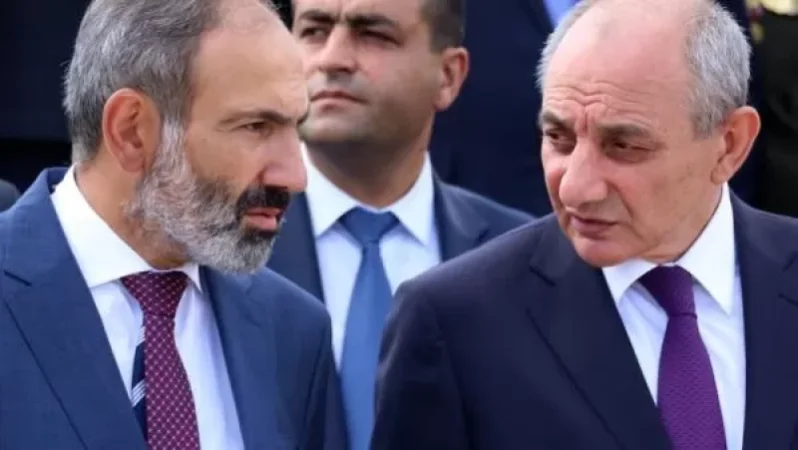
Prime Minister Nikol Pashinyan and Ms. Anna Hakobyan attended the inauguration ceremony of the newly elected President of Artsakh, Arayik Harutyunyan, in Shushi. The ceremony took place during a special session of the National Assembly of the Republic of Artsakh. Also present were the former President of the Republic of Artsakh Bako Sahakyan, the leader of the Armenian Apostolic Church in Artsakh, Archbishop Pargev, the President of the National Assembly of Armenia Ararat Mirzoyan, parliamentarians from Armenia and Artsakh, as well as public and political figures.
Following the ceremony, the Prime Minister and Ms. Hakobyan attended a reception where Prime Minister Nikol Pashinyan delivered a speech. According to the government’s press service, in his speech, the Prime Minister stated, "Your Excellency, President of the Republic of Artsakh Bako Sahakyan, esteemed Ms. Anahit Sahakyan, Your Excellency, President of the Republic of Artsakh Arayik Harutyunyan, esteemed Ms. Kristine Harutyunyan, Presidents of the National Assemblies of the Republic of Armenia and the Republic of Artsakh, state officials of Armenia and Artsakh, government members, National Assembly deputies, gentlemen generals and officers, spiritual fathers, ladies and gentlemen. Today, we have gathered in this magnificent corner of Shushi, the brightest symbol of the Artsakh Liberation War, to conduct the inauguration ceremony of the newly elected President of the Republic of Artsakh, Arayik Harutyunyan. This is a mandatory event established by the Constitution and legislation of the Republic of Artsakh, but the place and the time give it a special symbolism and meaning.
Years ago, during a visit to Artsakh in my capacity as an opposition MP, I made a statement: ‘Artsakh is the best place to think about our past and future, and there is a very specific reason for this in my opinion.’ Artsakh is the only part of our homeland where the vision of each one of us can be limitless, the only part of our homeland from which the horizon can be seen without particular technical efforts, because here the mountains do not close us off from the world and the endless horizon can be seen from here.
In our reality, it is accepted to consider the most important achievement of the Artsakh Liberation War the salvation of the Armenians of Artsakh from physical extermination, the tangible achievements brought by the liberation struggle in the form of today's Republics of Artsakh and Armenia. And this is a reality. But I believe that equally important is the philosophical and conceptual achievement that we have gained as a result of the Artsakh Liberation War: the accessibility to the horizon, the ability to connect with the limitless. The limitless horizon is a symbol of unlimited thought and a new way of thinking, a thought that is no longer confined by narrow canyons, mountain passes, and plateaus.
I am convinced that the most important achievement of the Artsakh Liberation War is the opportunity to perceive ourselves in a new way, to think anew, to be guided by a new way of thinking, and to lead others with this new way of thinking. In my view, thus, the greatest achievement of the Artsakh Liberation War is the change in our national thought.
The change in thinking always and everywhere occurs very slowly, invisibly, but usually, at some point, at some juncture, it has a bright and historic expression, and the non-violent, velvet, popular revolution that took place in Armenia in 2018 was such an expression—an expression of that change in thought that began in the collective consciousness of our people with the victory of the Artsakh Liberation War. This is an extremely important nuance that I want all of us to take note of. It was the change in thinking that brought about the non-violent, velvet, popular revolution of 2018, and this change in thinking was initiated by the victorious outcome of the Artsakh Liberation War.
The motto 'We are the masters of our country' arose in the second decade of the 2000s, and various groups and individuals fighting for change in Armenia adhered to it. But this slogan was realized without any chanting by the people of Artsakh, the people of Armenia, our fallen and living freedom fighters during the Artsakh heroic war in the first half of the 90s. The Artsakh Liberation War, in turn, was the result of another democratic revolution initiated in Armenia and Artsakh in 1988, which led to such a change in our national thinking that enabled the Artsakh Liberation War.
I say all of this to make a very important note: all attempts to oppose the non-violent, velvet, popular revolution to the Artsakh Liberation War and its goals and essence, its dreams and values, are in vain, and just as the revolution that started and won in 1988 led to the liberation of Artsakh, so too must the non-violent, velvet, popular revolution inevitably and necessarily lead to the de jure international recognition of Artsakh's actual self-determination.
And thus, my appeal and request is, let us not use our national energy and strength in any way, on any platform, for any reason, to divert ourselves from this goal, to tire ourselves out on this path, to exhaust ourselves, to make ourselves hopeless.
Moreover, continuing with the theme of changing thinking, I want to draw everyone's attention to a fact. Usually, we perceive our path and mission in terms of several years, sometimes decades, sometimes several decades, sometimes even worse, in terms of months and weeks. This is objectively understandable, since everyday problems, worries, agendas, as well as criticisms and intrigues forcibly put us in such a situation. A situation where we begin to perceive the situation in the context of past and future elections, but time flies very quickly between elections, especially since elections are often and various in a democratic society. And due to this circumstance, we often forget about the exceptional historical mission that is laid upon our shoulders, and the exceptional honor that we have had the fortune to deserve. By the way, this applies not only to government officials but also to all citizens, to the people, who have the exclusive mission of forming power in modern society.
And in this symbolic place and on this symbolic occasion, I want to state that we are not only people solving and proposing even exceptionally important current political, economic, and public issues, but we are also descendants of a proud and victorious people with a multi-thousand-year history descending from Hayk Nahapet, descendants of the wealth of the Kingdom of Van, the Ervandunians, the Artaxiad dynasty, the Arsacid dynasty, the Bagratids, the Cilician kingdom, and we should consider our mission in the chain of thousands of years past and future. Whose mission is to free ourselves from the burdens of the failures of previous millennia and to revive the formulas of success from previous millennia, transforming those formulas into national thinking and national identity, and thus ensuring the creative competitiveness of future generations on the planet.
Let us therefore state that we are de jure the continuators of the illustrious kings and thinkers, statesmen and teachers, architects and builders, scientists, writers and progressives, commanders and diplomats, industrialists and entrepreneurs of our glorious past; and we should strive to become that de facto as well. Or at least we should create real opportunities for that for our successors.
And I would like us to lay this very advice as the foundation of our solemn ceremony today.
Ladies and gentlemen, returning to the direct and primary content of today’s ceremony, first I want to thank the third President of Artsakh, Bako Sahakyan, for his service to the people of Artsakh and Armenia, and especially for our joint work over the past two years. Recently, during our discussions, I mentioned that now I want to repeat publicly: after the non-violent, velvet, popular revolution that took place in Armenia in 2018, no one has been in a more difficult situation than the President of Artsakh, Bako Sahakyan. Moreover, that situation has been difficult both politically and morally, personally, and state-wise, filled with numerous dilemmas, traps, and ambiguities.
In the last year, our relations have inevitably borne the seal and influence of these dilemmas, ambiguities, and traps, but I can honestly say that we have overcome all these obstacles without exception, and now I can say that in Bako Sahakyan, the third President of Artsakh, I have found a reliable friend and ally, and I am happy and grateful for that.
And finally, I congratulate the newly elected fourth President of Artsakh, Arayik Harutyunyan, on the occasion of assuming the office of President of Artsakh! I am confident that during Mr. Harutyunyan's presidency, the cooperation between the Republics of Artsakh and Armenia will become even more effective.
The Government of Armenia has closely monitored the electoral processes occurring in Artsakh. Before the elections, some predicted that a revolution would occur in Artsakh, while others speculated that there would be a counter-revolution. From the outset, my position has been that Artsakh should not be a stage for either revolution or counter-revolution. Artsakh could not be a counter-revolutionary stage precisely because part of our people cannot and could not naturally oppose another part of our people within any scenario. Artsakh did not need to become a stage for revolution either since, as I have said, the people of Artsakh were full participants in the revolution of 2018, and thereafter, there were forces and candidates among the participants of the presidential and parliamentary elections in Artsakh who unequivocally and unconditionally welcomed the non-violent, velvet popular revolution and expressed their unambiguous and unmistakable support and loyalty to the popular government of Armenia.
In both parliamentary and presidential elections, these very forces won a decisive victory, and it is precisely such a political figure—Arayik Harutyunyan—who became the President of Artsakh. This election signifies that although there was no revolution taking place in Artsakh per se, Artsakh is entirely and unequivocally part of the revolution, and the people of Artsakh have expressed their unambiguous will to undertake reforms through the outcomes of the elections.
In this regard, the newly elected authority in Artsakh, along with the authorities of Armenia and Artsakh, have a collective and unified responsibility towards the Armenian people to implement reforms in Armenia and Artsakh. People need to see changes; they need to feel these changes—political, economic, social, anti-corruption, human rights protections, an independent judiciary, freedom of speech, electoral fairness and reliability—and I am confident that these changes will take place. This is not merely a political statement but a clearly articulated understanding—if not an agreement—between the leaders of Armenia and Artsakh. And I want to clearly emphasize, Mr. Harutyunyan, that I believe in your political will and determination to pursue the path of reforms and creative changes.
I believe that your extensive experience of being the Prime Minister of Artsakh for many years should not lead us down the paths of the past, but should help us avoid repeating our past mistakes, and should help us learn wise lessons from our past errors because our mistakes are our greatest teachers, if we have the will to learn, our mistakes are our greatest motivation for moving forward and overcoming obstacles, if we have the will to move ahead.
And by the way, when we speak of changes, we all usually understand the physical characteristics of changes in reality: built roads, renovated schools and kindergartens, water lines, and parks. All of these are immensely important. But a constructed road can be destroyed, a renovated building and school can wear out, a water line and park can become unusable, thus showing the superficial, formal nature of a change. The same applies to so-called new and old officials because everything is relative—new officials can quickly acquire 'old' traits, and old officials can perceive the situation and mission in a new way, learning lessons from past mistakes.
Therefore, the change that occurs within us, within each one of us, in our thinking and psychology, in our behavior and conduct is far more important and lasting. And thus, I believe that the time for these kinds of changes has come in our national life, in our individual behavior—from the president to the ordinary citizen, from the prime minister to the ordinary soldier.
Times of such changes, the results of which will allow us to look directly into the eyes of our martyrs, our children, our mothers, our women, and our sisters. And thus, long live freedom! Long live the Republic of Artsakh! Long live the Republic of Armenia! Long live us and our children, who live and will live in a free and happy Armenia, in a free and happy Artsakh!
Նմանատիպ հոդվածներ
Ավելին Politics բաժնից
Ուկրաինան չի մերժել հայկական արտադրանքը․ ՍԱՏՄ-ն բացահայտում է
Հունիսի 7-ի այսպես կոչված ընտրությունների պաշտոնական արդյունքները կեղծ են․ ՀՀԿ ԳՄ
Թրամփը՝ Իրանում հնարավոր իշխանափոխության մասին