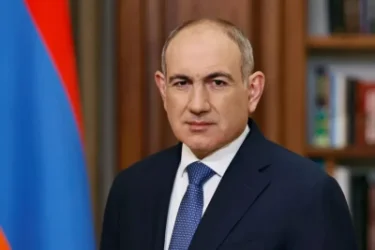
Pashinyan's Interview with Nouvelle d'Arménie Magazine

Prime Minister Nikol Pashinyan has given an extensive interview to the magazine Nouvelle d'Arménie. "Armenpress" presents the complete version of the Prime Minister's interview titled "The Time of Power" in Armenian.
Q: It is now approaching 500 days since your rise to power. You bear the heavy responsibility of carrying Armenia's fate. Is everything as you imagined? What has been more difficult than expected, and what has been easier?
A: I have an opportunity to say that the categories of "easy" or "difficult" do not apply in this case. There are no easy tasks in governing a country. Like any activity, governance is inherently a complex amalgam of various aspects. The greatest success, which I have already emphasized, has been the establishment of democracy in Armenia. I speak of democracy not in a narrow sense. In your question, you mentioned that I carry the responsibility for Armenia. Yes, that is true; I have never escaped and will never escape my responsibility. The idea of democracy is that Armenia is not a dictatorship; it is not governed by a dictatorial regime. My main message, which I have carried since the beginning of my political career as an opposition figure and even before that, is that every citizen has their share of responsibility in everyday life.
Q: Undoubtedly, some responsibilities are more visible than others. Realities, processes begin imperceptibly, on a small scale, evolve and reach a climax. The same was true in the case of the Velvet Revolution. This is why I initiated the process that led to the revolution, but if we study our society more attentively, we will see that this process started a long time ago. The seeds were present on a molecular level, in various fields—economic, social, and so on—and their evolution weakened to reach the goal. Obviously, in this process, some aspects are more tangible than others.
My vision for Armenia's development is that the victories we should achieve should not be generated only in one direction—from the government to the people. They should be carried out in both directions. This will happen in a systematic way if there is a certain mutual understanding between the people and the government, and if their aspirations, goals, and ideas align. Today, Armenia's great uniqueness lies in this: the government desires what the people want, the government thinks the same way as the citizens do—though not all citizens, but at least the majority.
One of the significant obstacles to change, one of the great difficulties arises from the generalized corrupt system in which Armenia has lived for many years. Micro-corruption had been a natural, everyday practice: minor problems were resolved through that micro-corruption. In a very short period, the situation has changed. Issues are no longer solved by corruption, and therefore sometimes they remain unsolvable altogether. Why? Because the state system has been accustomed to this way of functioning. The laws have been written, I repeat, to satisfy Europe and not to regulate social relations; the law was merely a facade, a show of external luxury, and behind it, issues were solved through small and large corruption.
Today, we have crossed this way of functioning and are trying to build the life of the country while respecting the rule of law. But we understand that the laws are not designed to serve that purpose, and therefore it is impossible to organize life efficiently. Hence, our greatest challenge from now on is aligning and adapting those laws to our reality, our deep aspirations.
Q: The greatest concern for Armenians is related to security. What can you say to reassure them? In your opinion, where do the main threats to the country come from?
A: As long as the Nagorno-Karabakh issue is unresolved, it is premature to speak of mechanisms for alleviating these concerns. We have a conflict, and that conflict is not resolved. If we are a people endowed with strategic thinking—and I am confident we are—we cannot solve problems in a short time, in a few days. We must realize that we have a problem whose solution requires the gathering of national potential. For this, it is essential that Armenian society and the economy be competitive, inclusive, and constantly on the path of development. We must ensure our economic progress with the utmost seriousness.
The Nagorno-Karabakh issue cannot be resolved solely through diplomatic or military means separately. A broader combination is necessary, centered on a strong and competitive economy, a powerful society, and a country with advanced technologies. I have repeatedly said that our program is to make our potential adversaries understand that we, as a people, are so united, as a society so cohesive, as a state so powerful, that it is meaningless to wage war against us, as the only outcome would be their defeat. There is no need for mutual reassurances. We must understand that we have a problem, and that problem concerns all of us. Undoubtedly, solving that problem is the government's and my personal priority.
I see my task not merely in uniting national forces; it should not be about uniting for the sake of uniting. My task is to create real opportunities for uniting and developing our national potential.
Q: If I understand you correctly, you connect the issue of security with economic development.
A: Yes, undoubtedly. Moreover, we cannot connect it with any other field in such a direct manner. To have strong diplomacy, a powerful army requires resources generated by our economy. And how is our economy built? We cannot regulate military conflicts and geopolitical complexities solely based on an economy engaged in exporting apricots. Let there be no misunderstandings: I believe agriculture is important; it makes up 14 percent of our GDP. But this is not the economy of a conflict-affected country. The volumes of agricultural products need to grow because there are many untended lands in our country. The quantity of agricultural products must be increased but its share in GDP must be decreased. The agriculture sector's production and export volume should grow tenfold, but at the same time, its share in the GDP must be reduced from 14 percent to 1—for all possible consequences. The same goes for the mining industry.
Q: What do you intend to do to reduce Armenia's economy's dependency on the mining industry?
A: The only possible way is the development of technologies and the processing industry. And I believe that one day it will be necessary to consider a law prohibiting the export of raw materials and mineral resources from Armenia. But that will be possible only if we have large smelters, molybdenum processing plants, and a complete mining industry within the country. This is the path we intend and must take.
No underdeveloped country has succeeded in defending its interests in a conflict. Everything is linked to economic health. In the first quarter of 2019, Armenia registered the greatest growth among all European countries. There is not much to rejoice about, as we have started from a very low base. But it is a good and real sign.
What is our government’s greatest success today? Well, of course, the greatest success is that we have transitioned from an oligarchic economy to an inclusive economy that allows everyone to engage in entrepreneurship. The economy today is free. Whatever the area of activity, there are no restrictions. Some time ago, to produce, import, or export required compliance with the rules crafted by the oligarchs. But that time has passed, and obstacles have been removed. Now everyone can invest, work, and showcase their talent. Politically, there are no hindrances, of course. On the other hand, there are other barriers: finding sources of financing, high-interest rates, inadequate infrastructure, roads that need to be built, and so on. This is the ecosystem we need to build. This is what we are trying to do.
Q: There seems to be a cooling of relations with Artsakh. What are the points of disagreement?
A: I think it is inaccurate to say that our relations with Artsakh have cooled, as dozens of officials are in constant contact and work together every day. It should be stated clearly: The authorities of Artsakh have long worked with the previous government—with all the consequences that could have resulted from that. Today there is a new government in Armenia, and it is natural that there are differences in certain issues (to speak directly—dissonance). It is necessary to act to eliminate those differences. The best means of achieving this would be the parliamentary and presidential elections scheduled next year in Artsakh. After those elections, which will be free and democratic, those disagreements will be resolved.
Q: Does that mean that the status quo will prevail in your relations until the elections?
A: Our relations change every day. They are developing well. Every day we present fundamental issues and find answers to them. We believe that improvements in Artsakh should occur at the same pace and same order as in Armenia. After all, we are talking about unity, are we not? This unity should be manifested first and foremost in political and public harmony. Now it is essential to establish harmony in the political domain; between Armenia and Artsakh in terms of political content, I need to say that I am convinced that the societies of Armenia and Artsakh are in harmony, but it remains to harmonize the governance systems. And that harmony should deepen every day, with every action taken. In this process, of course, there are differing approaches. But what do we want to achieve? Do we want to behave as we did before? To hide problems? Avoid discussing them? Raise toasts and pretend that there is nothing? We will continue to toast only at the table. In the remaining cases, we speak directly, with utmost sincerity, and act.
Q: What do you think, have the doubts that may have arisen among our strategic ally Russia after the Velvet Revolution been overcome? Does Armenia continue to be Russia's strategic ally, and vice versa?
A: The formulation of the question suggests that Russia has a legitimate right to doubt regarding Armenia, while we do not have the right to doubt it. Russia always had the right to doubt, and we have always been in the position of the doubted. And why does no one think to inquire if there are mutual doubts in Armenia-Russia relations? For example, when Russia sells weapons to Azerbaijan, is that a subject of doubt or not? I want to say that we must rid ourselves of our age-old complexes; we are sovereign partners, and if they have the right to doubt us, we are equally entitled to doubt them. Overall, I believe that it is on this important foundation that our relations should develop and continuously improve. We must establish relationships that respect the dignity of each party. I am confident that today our relations are marked by that dignity.
We are equally entitled to doubt anyone as much as anyone can doubt us. And if someone thinks that we are not fulfilling our obligations towards the partner at the required level, we are allowed to do the same.
Let no one think that the removal of doubts should be merely on our agenda.
Q: Is it possible to be both a strategic ally of Russia and a defender of Western values, such as democracy, freedom of the press?
A: Let’s remember Peter the Great. He started his journey in Europe. He traveled to European capitals and then went to Russia and, due to his efforts, succeeded in convincing Russia to intervene in the affairs of our region. Other countries were also ready to take on that role, but for various reasons, that did not happen. Why do we give so much significance to our relationship with Russia? Because we have always regarded Russia as a force that imbued our region with European values. This fact is essential. We did not seek intervention from any backward country, but invited Russia because it was one of the most advanced countries in Europe. What did Peter the Great do? Why did he send young people to Europe for education? Why did he adopt European values? Why did he not send young people elsewhere? What do European values mean, and what do Russian values mean? Is today’s Russia the carrier of Peter the Great's values or not? If yes, then there is no contradiction between Russia and Western values; the fact is that even in Europe, things do not hold the same understanding: Poland has its unique approach to European values, France has its approach, Great Britain voted for Brexit. What does this mean? These same European values are not just European; they are also ours. Why? Because we also had our great share in the formation of those values. Grigor Narekatsi's "Book of Lamentations" had an immeasurable impact on today’s European reality.
For me, European values are our values, just as they are for France, Great Britain, Russia, because we have created them together.
Hence, our aim is not to realize European values in Armenia but to realize our values that we have developed and mixed in the same European pot giving birth to one whole. These are our values, and our revolution is the best proof of that. How is it possible that we carried out the most popular revolution in Europe? Because democracy is our genetic value. The women of the First Republic of Armenia already had the right to vote, while many countries in the civilized world deprived women of that right. In the very heart of Europe, women did not have that right until the 1960s. So can we say that we exported this value to Europe?
Q: We are witnessing a rapprochement between Russia and Turkey. Does this pose any danger to Armenia?
A: I have already addressed this issue in one of my previous answers.
Q: Do the US sanctions against Iran hinder Armenia?
A: I do not want to make sweeping statements, but our diplomats have managed to achieve a very important victory in this regard: it seems that our American partners have been able to understand the issue well. They have started to realize that for Washington Iran is one thing, and for Armenia, it is another.
Q: Do they really understand this?
A: Our latest interactions indicate that yes. Which does not mean that their attitude towards Iran changes as a result.
Q: Are they putting pressure on Armenia in this regard?
A: I can say that at this point, we are not subjected to any such pressure. Armenia is not under pressure as Armenia, but as part of the international community, being a neighboring country to Iran. I want to say that there is no uniform approach, and I am glad to see that our American partners seem to have grasped the depth of the context in which Armenia is situated.
Q: Doesn’t the further course of the revolution depend on the reduction of inequalities? Is your liberal and business-friendly political approach the first step in that direction? Will addressing social issues follow, or will you be able to solve both at the same time?
A: Why later? We have already begun addressing the issues related to inequalities. The allowances and the minimum needed for living were raised at the beginning of this year, aligned with the minimum consumer basket, and military personnel's pay has also increased. Following September 1, that trend will also follow with teachers' salaries, and from January 1, pensions will also be revised, while the micro-business is fully exempt from taxes; starting January 1, the incomes of 140,000 workers will increase thanks to changes made in the Tax Code. Since July 1, 2018, more than 200,000 workers have seen their incomes rise due to reforms in the pension system. We opened and expanded access to the business sector. A characteristic of the corrupt system that prevailed in the past was keeping people in poverty and leaving them without social safety nets to be able to buy their voices with 5,000 drams during elections and win elections this way.
Democracy does not need such a system; it needs economically autonomous individuals. We say this to people: when for 20-25 years oligarchs distributed free rice to persuade you that they ensured your welfare, they deceived you. The only way to ensure your economic prosperity is work. We tell people to see what we are doing, judge by the result: we are exempting micro-business from all taxes, we are making healthcare services for those aged 0-18 free throughout the entire nation, and we are expanding that free healthcare service to vulnerable groups, military personnel, and more. Social benefits are increasing so that everyone can access the vital minimum. We say to people that we are solving the problem of access to medical services, the problem of access to the minimum consumer basket. In terms of education, we are ensuring that no student is expelled from courses due to financial difficulties. But we also say: you are the ones who must take care of your family's needs. You cannot turn to the government and say, 'Give me a chair.'
The government states, 'We provide you with medical insurance for you and your children, we ensure a minimum income for you to not go hungry; go and work to create your own chair. You cannot ask the government to buy you a television; you must work and buy a television with your means. The government's task is to create conditions necessary for work.' Today, there are thousands of vacant positions in Armenia. In the same approach, we are implementing tax reforms. Today in Armenia, there are three tax brackets: a 36% tax for high incomes, 27% for middle incomes, and 23% for low incomes. We are reducing the rates for everyone to 23%, and over the next five years, we will reduce it to 20%. Some accuse us of implementing favorable policies for the rich. We respond, yes, truly, because the one who has a high income has not spent his time cowering under a tree doing nothing, excuse me for saying this in harsh terms. But ultimately, a person who learned to get a competitive education will have the right to reap the fruits of his efforts. This is how I see the future of Armenia; there should be no uneducated workers in Armenia. This is the message we must convey to youth.
Q: The goal is clear, but time is needed to achieve that. What should unqualified workers do in the meantime?
A: For some of those workers, the measures taken for the benefit of micro-business, the lifting of all taxes are responses to those challenges. We say to those people, 'It’s not normal for a person to work for 60,000 drams for 5 or 10 years.' We say to that person, 'That is not your sole income; it will not secure your future. We relieve you of taxes, we offer you low-interest loans; engage in entrepreneurship, unleash your creativity, create your own business and earn not just 60,000 drams, but 70,000, 100,000 or more.' Even in the tourism sector, starting from the beginning of this year, tourists have spent $120 million more in the Republic of Armenia than the same period last year. We say to that person to work and have his share of that $120 million instead of merely being content with 60,000 drams for the rest of his life. Our strategic choice is the development of processing industry; we pursue high-income oriented policies, we are reducing taxes so that business leaders can increase their employees' salaries.
Q: How is it possible to lower taxes on one hand while simultaneously pursuing social policies? How do you fund these measures?
A: We are already doing that. There was a vast shadow economy in the Republic of Armenia. Thanks to the fight against that shadow economy during the first half of this year, we managed to generate an additional budget revenue of $120 million. Because of that growth, we could increase our military personnel's remuneration.
Q: So you have your financial means for your policies.
A: Of course. We tell citizens that you cannot make purchases without a cash register invoice and on the other hand demand pensions to be increased. With what resources do you want them to be increased? The state treasury is that common wallet to which we all contribute our share.
Q: Allow me to insist that the tax reduction policy is primarily favorable to the wealthy. Doesn’t this further deepen the gap between the rich and the poor?
A: No. We believe that the difference between the rich and the poor should be reduced. We believe the poor should become rich. This is Armenia's future. We must encourage business, develop the economy, reduce the share of agriculture, and increase that of industry. We need to strengthen the education system. We want to make Armenia a paradise for talents. We are convinced that every human being is gifted, and thus it is our job to facilitate each one in utilizing their talent. If not everyone can become rich, then everyone should at least have a decent life economically. Armenia is a country where everyone deserves the right to enjoy prosperity, and this will be achieved through education, work, and respect for legality. These are the three cornerstones that will allow us to reach our goal.
I want to return to the unqualified worker. We say to him, 'If by unfortunate chance your child gets sick, that is our problem, not yours.' In other words, we are changing the benefits system so that the person receiving the aid becomes the child and not the parent, thus freeing the latter to go to work, as our system is constructed in such a way that beyond a certain income threshold, social benefits disappear.
We say to him, 'You are not the beneficiary of the aid, and therefore, you can work as much as you want; we provide benefits for your child until he is of age; we take care of your child's health and education, as well as your medical expenses. Be healthy, work, and earn your livelihood.'
Q: What incentives are you considering for the return of Armenians? The current Constitution prohibits dual citizens from accessing public office. Are there any planned reforms?
A: I have already mentioned that we plan to make changes to that law. But I want you to understand that our reform agenda is very saturated. If we try to solve all issues simultaneously, we will solve none. Despite the constitutional barriers, we see in our high officials some who have returned to Armenia. Of course, they are not ministers, but they are vice ministers or appointed to responsible posts. And this process will gain traction. But I have already repeated many times that we must amend the Constitution to remove the barriers arising from nationality and permanent residency, thereby opening the doors of the Government of Armenia and the National Assembly to our compatriots from the diaspora. Nevertheless, we will have to implement this reform while crafting conditions under which the Republic of Armenia, as a state structure, does not lose its uniqueness.
The best way to encourage the return of diaspora Armenians is the existence of a unified homeland, both in the literal and metaphorical sense. The best incentive will be for every Armenian to consider Armenia more and more their own every passing day.
Unfortunately, I can note that some of our compatriots who have had to settle in another country consider as their homeland the one where they were born, for instance, Lebanon or Syria. An Armenian has no other homeland than the Republic of Armenia, and I believe that in this regard, the Velvet Revolution has played an important role, as every Armenian has had a chance to participate in it through social media among other means. That sense of belonging to the homeland needs to be strengthened. And when we talk about the inclusive, entrepreneurial system, we also speak about the Diaspora. Our goal is to create conditions for diaspora investors to gather in Armenia.
We are beginning a new phase. In Armenia-Diaspora relations, I identify three phases—even though they are, of course, intertwined. The first one I consider to be the war period that came after the collapse of the USSR when the country had a vital need for social assistance, and we must admit that the assistance of our compatriots from the Diaspora, who sent us clothes, food, water, money, humanitarian aid, truly saved us. That phase has reached its objectives and is over.
The second phase began when the Diaspora started maturing the idea that humanitarian assistance was no longer sufficient, and especially development programs were essential. I stress especially because this does not exclude other forms of assistance; since that division is not impermeable, such investments can be intertwined. Those programs can manifest in achievements like Tumo or the SMART center and other educational initiatives in that series.
The third phase is the Diaspora’s participation in the development of Armenia's economy, turning our homeland into a technological and industrial country. Since new technologies and venture capital have a colossal impact in terms of investments, our job is to create conditions for that impact to favor Armenia's economic development.
Q: Mr. Prime Minister, let’s imagine that I am a businessman who wants to invest in Armenia. Who should I turn to? What should I do?
A: First, I want to say that if you wish to settle in Armenia, you do not need to take any steps. You come, buy real estate if you want, and start living. This is what many of our compatriots do. If we compare this year’s figures with last year’s, we see an 11.1% increase in the volume of real estate transactions. Real estate prices are steadily rising as the demand for apartments is great.
In terms of investments, we have two structures serving two types of investors—large and small. For large investors, a relevant office has been created a few months ago, led by David Papazyan—the State Interest Fund of Armenia. This structure deals with issues related to certain levels of investment. Regarding small and medium investments, we have another body—the National Center for Development of Small and Medium Enterprises.
Q: But isn’t it a way to limit the role of the Diaspora solely to the economic sphere? What steps are you taking regarding other fields as well? The Diaspora has always represented political power, a lobby. What are you doing in that regard?
A: There is absolutely no objection regarding the activities of the Diaspora in other spheres. What I am saying complements everything that has already been done without leaving anything out of the previous actions. It is crucial to emphasize this. For example, what we are doing for the international recognition of the Genocide, for Karabakh, and lobbying in general for Armenia, are certainly important directions. But we must also evaluate the reality prevailing in the Diaspora and ask ourselves whether the potential of the Diaspora is being utilized effectively.
You know, such discussions are not well perceived, but...
Q: Is the activity of the Diaspora in line with Armenia’s expectations? In your opinion, in which areas should it be more engaged?
A: Now let me point out what the problem is that we face regarding the structure of the Diaspora. 30 years ago, 90% of the Diaspora was involved in recognized organizations—major establishments of the Diaspora. Today, 90% of the Diaspora has distanced itself from these structures, meaning that we do not have clear communication linkages with 90% of diaspora Armenians today. We made changes in the government structure, abolishing the Ministry of Diaspora, instead creating the Office of the High Commissioner for Diaspora Affairs. The number one task of the High Commissioner is to map the entire potential of the Armenian Diaspora around the world, so that we can solve any problem in any field in a few moments. It will take only a few moments to know in any field who are the Armenians present in that country, their status, and their level of influence. We need to be in contact with everyone; we need to have the ability to communicate with any Armenian in person, establish a connection with him and talk.
We need a system that will allow us to have a list of names and numbers at hand for those who can solve a given problem—be it political, economic, cultural, or in other fields. Our state has existed for 30 years, and we have failed in this regard. Of course, we have information about the most active circles of the Diaspora, which is very good, but that bunch is not the whole. Therefore, the elitist policy towards the Diaspora needs to change in accordance with the changes that have taken place in Armenia. Today in Armenia, decisions are not made by a select group of leaders from above; now the people are making decisions, and the people are fully involved in the political and economic processes of the country. And of course, the same should happen in the Diaspora.
[The interview was conducted in Yerevan by Benyamin Keshishyan and Hilda Keshishyan.]
Նմանատիպ հոդվածներ
Ավելին Politics բաժնից
Նիկոլ Փաշինյանն Ալեն Սիմոնյանի հետ դաժան վարվեց. ինչ է սպասվում․ «Ժողովուրդ»
Խուզարկություն է ընթանում քաղաքագետ, «Մայր Հայաստան» շարժման անդամ Երվանդ Բոզոյանի բնակարանում
ՔՊ-ում որոշել են ազատվել նաև Անդրանիկ Քոչարյանից. «Ժողովուրդ»